Lagoon 450 Review: 850 Hulls, Two Variants, One Generation (2026)
The Lagoon 450 (2011–2021) is a 45 ft 10 in cruising catamaran with more than 850 hulls built. Used prices range from approximately €265,000 for ex-charter early hulls to €540,000 for upgraded 2020 owner's versions (as of August 2026). CE Category A certified, it offers genuine ocean capability, but buyers must investigate the documented forward bulkhead cracking issue before purchase.

850+
hulls
Total built
€265k–€540k
Used price range
45 ft 10 in
LOA
Length overall
2011–2021
Production years
What the Lagoon 450 actually is
The Lagoon 450 is a production cruising catamaran built in Bordeaux, France, by Lagoon Catamaran between 2011 and 2021. With more than 850 hulls completed (as of August 2026), it became arguably the most commercially successful 45 ft catamaran of its generation. Naval architecture came from VPLP (Van Peteghem / Lauriot-Prevost), interiors from Nauta Design, and exterior styling from Patrick le Quément. It was the first Lagoon to feature the Nauta Design collaboration that now defines the brand's look.
Two principal variants exist. The 450F (flybridge) ran from 2011 to 2019, offering an elevated helm station and social area above the saloon. The 450S (SporTop) arrived in 2016 and continued until 2021, with a lower boom (70 cm lower than the F), a shorter mast (22.36 m vs 23.05 m air draught), and a resulting lower centre of gravity. Both share the same GRP polyester fiberglass sandwich hull, vacuum-infused, and both carry CE Category A (Ocean) certification, confirmed on the official Lagoon spec page for the 450S and expected for the 450F given its identical hull platform.
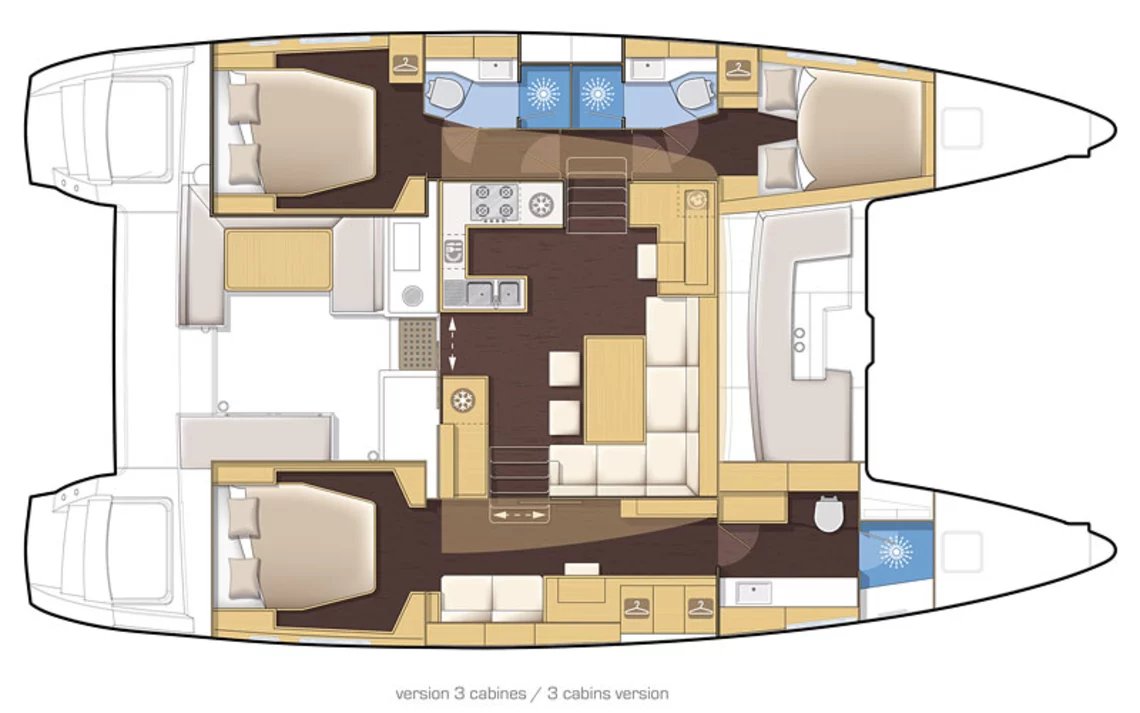
Layout options include a 3-cabin owner's version (6 berths, 2 heads) or a 4-cabin charter version (8 berths, 4 heads). Standard power is twin Yanmar 4JH45 diesels at 45 hp each, with a later 57 hp 4JH57 option. Fuel capacity sits at 1,040 L across two tanks. Water is a more modest 350 L, making a watermaker essential for extended cruising.
The 450 succeeded the Lagoon 440 (423 hulls, 2004–2010) and was itself replaced by the Lagoon 46 starting in 2019. A 2015 remodel brought interior restyling and a reinforcing rib at the forward end of each hull. In 2025–2026, Lagoon announced a '450 NEO' retrofit programme, breathing new life into older hulls.
Sailing performance
Upwind and light air
The 450 is not a performance catamaran. At a light-ship displacement of 15,000 kg (450S), and possibly as high as 16,900 kg for the 450F according to SailboatData (though this contradicts other sources), it is a heavy boat for its waterline length of 13.39 m. Sail area upwind is 130 m² on the 450F (79 m² full-batten main, 49 m² genoa) and 132 m² on the 450S. Below Beaufort Force 3, the standard rig struggles to move that mass efficiently.
If you plan to sail in chronically light-wind areas, look for boats fitted with the optional 81 m² square-top mainsail or the 93 m² Code 0 for downwind work. These upgrades change the light-air character from frustrating to functional.
Reaching and downwind
In Force 4 to 5 conditions (11–21 knots of true wind), the 450 comes alive on a reach. The fractional sloop rig with two swept diamond spreaders and 1×19 stainless-steel wire standing rigging provides reasonable stability. The twin fixed keels draw just 1.32 m, allowing gunkholing in shallow anchorages that deeper monohulls cannot enter.
Handling notes
Some owners have reported that the helm steering feels very stiff, an issue traced to the rudder cable and linkage system. This appeared on a Cruisers Forum thread as early as 2016. Before committing to a purchase, insist on a sea trial in at least Force 3 to feel the wheel resistance yourself. A stiff helm on a catamaran is a fatigue issue on long passages, not merely an annoyance.
Light-Air Sailing (standard rig)
What owners praise
The 450's commercial success was not accidental. Owners consistently highlight three strengths: liveability, sea comfort, and the sheer availability of parts and knowledge for a boat with 850+ siblings.
Liveability and space
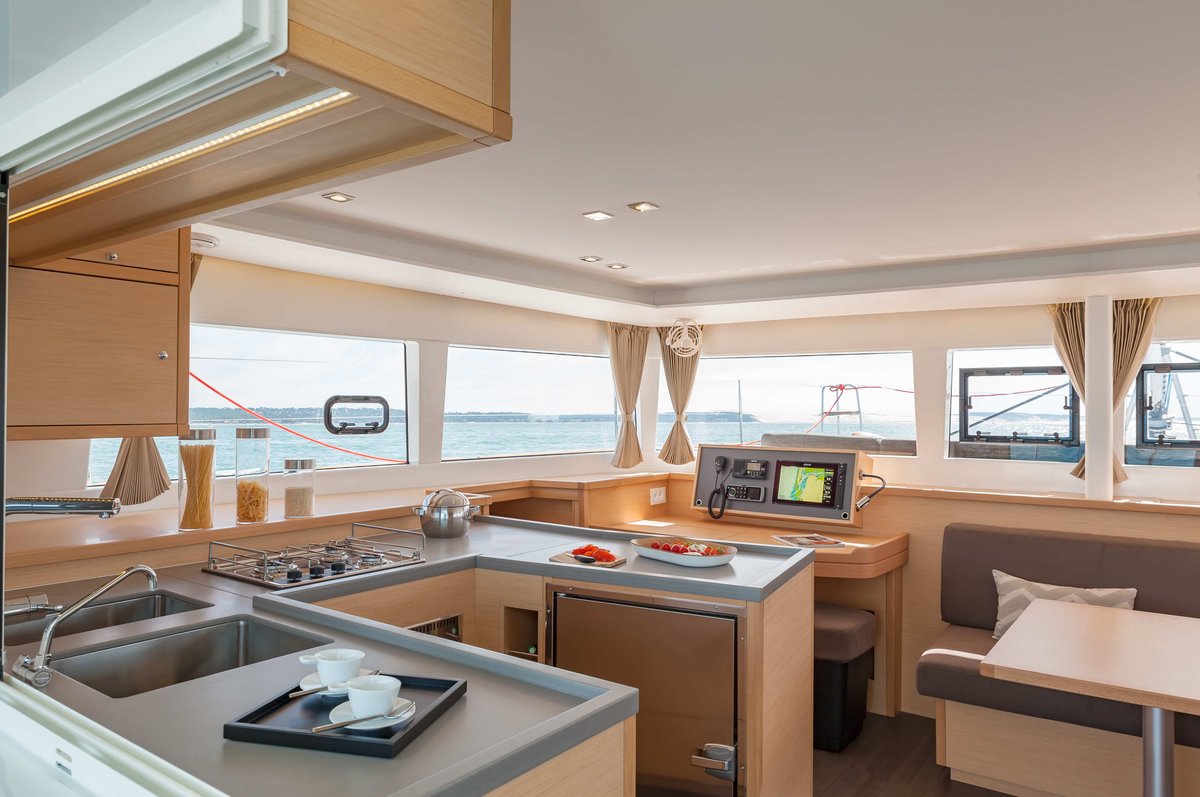
Maximum headroom of 203 cm (6 ft 8 in) means even tall crew walk upright throughout the saloon and cabins. The owner's 3-cabin layout gives the master suite a full-beam cabin in one hull, with a dedicated head and separate shower. The beam of 7.87 m makes the bridgedeck saloon feel more like a studio flat than a boat interior. If you're a couple considering whether a catamaran this size is overkill, it might be. Take a look at our guide to the best yachts for couples in the 32–36 ft range before deciding.
Sea comfort
"Our biggest pleasant surprise is her sailing ability and comfort at sea," reports Estelle Cockcroft, co-founder and owner of a 450S (Catamaran Guru, 2024-06-02). The 450S's lower boom and shorter mast reduce pitching in a seaway compared to the flybridge version. The 2015 remodel's added reinforcing rib at the forward hull section improved structural stiffness on later boats.
Blue-water credibility
CE Category A certification for up to 12 persons is not a marketing label. It means the boat met EU structural and stability standards for unlimited ocean passages. "This Lagoon 450S is a really good, comfortable live-aboard blue-water cruiser," says Estelle Cockcroft (Catamaran Guru, 2024-06-02). The 1,040 L fuel capacity across twin tanks gives reasonable range under power for windless passages or canal transits.
Fleet-size advantages
With more than 850 hulls afloat, finding replacement parts, comparing refit solutions, and joining owner groups is straightforward. This is not a niche boat. Yards in the Mediterranean, Caribbean, and Southeast Asia know the 450 well, which keeps maintenance costs lower than on rarer models.
✓ Strengths
- •CE Category A ocean certification
- •203 cm headroom throughout
- •850+ hulls = parts availability and yard familiarity
- •1,040 L fuel capacity across two tanks
- •1.32 m draught opens shallow anchorages
- •450S lower mast/boom reduces pitching
✕ Trade-offs
- •Forward bulkhead cracking documented on multiple hulls
- •Heavy displacement limits light-air performance
- •Stiff helm steering reported (cable/linkage issue)
- •No deck hatches in coachroof limits saloon ventilation
- •350 L water capacity — watermaker needed for cruising
- •Many ex-charter hulls with heavy wear
Weak points and what they cost
Forward bulkhead cracking: the headline issue
The most serious known problem with the Lagoon 450 is cracking and delamination of the forward (mast) structural bulkhead. This bulkhead sits directly under mast compression loads. Lagoon acknowledged approximately 40 confirmed cases by May 2021, out of more than 850 boats sailing. The causes are debated: Plexus methacrylate bonding without adequate fibreglass tabbing, unsealed plywood end-grain, and stress concentration at the mast partner have all been cited.
Practical Sailor reported that in most reviewed cases, it was "very unlikely that the failures were due to extraordinary circumstances." Lagoon offered free dealer inspections and case-by-case repairs, but the repair kit came with only a 1-year warranty. Owners on YBW Forum found that detail frustrating, since it effectively shifted long-term liability back to them.
What this means for buyers: commission a surveyor experienced with Lagoon catamarans to specifically inspect the forward bulkhead bonding. Budget a minimum of €5,000–€15,000 for professional repair if issues are found, though costs vary widely by location and severity. Walk away from any boat where the seller has not allowed or documented a bulkhead inspection.
Broader structural bonding concerns
Owner teardown videos, notably the well-documented 'Parlay' refit, showed that multiple non-forward bulkheads were bonded only with bog (filler), without fibreglass tabbing. Dry laminates and unsealed plywood end-grain were also documented. As one YBW Forum poster noted: "The 450 weighs 15 tonnes and seems to have some low quality 1/2" plywood for bulkheads" (anonymous poster, YBW Forum, 2022-07-19). The 2015 remodel addressed some of these issues, so post-2015 hulls may be less affected, but a thorough survey remains essential on any model year.
Ventilation
The coachroof lacks deck hatches in the saloon. In tropical climates, the bridgedeck living area depends on opening windows and powered fans rather than natural convection. If you plan to cruise without air conditioning, this is a genuine comfort penalty. Retrofit hatches are possible but involve cutting into the coachroof moulding, a job best done at a specialist yard.
Charter fleet wear
An estimated 70%+ of 450F production went into charter fleets. These boats accumulate hard hours fast. Charter-fleet examples carry higher risk of osmosis blistering on the GRP sandwich hulls, worn rigging, and tired engines. Practical Sailor warned that resale value can drop sharply if bulkhead or blister issues are disclosed. Always ask for engine hours, rig inspection dates, and antifoul history. On ex-charter boats, ask for the charter company's maintenance log. Silence on that question is informative.
Lagoon 450 price: what the market asks
The Lagoon 450 is one of the most liquid catamarans on the used market. As of August 2026, approximately 220–250 listings exist globally across all sub-variants (450, 450F, 450S combined), spread across YachtWorld, boats.com, iNautia, Boat24, Band of Boats, YachtAll, and Rightboat.
| Category | Typical profile | Price range (EUR, as of August 2026) |
|---|---|---|
| Entry level | Ex-charter, 2011–2013 hull, high engine hours | ~€265,000 – €310,000 |
| Mid-market | 2014–2016, moderate use, some upgrades | ~€310,000 – €450,000 |
| Top of market | 2017–2020, private/lightly used, owner's version with upgrades | ~€450,000 – €540,000 |
These ranges are estimated from observed data points on iNautia (€290,050–€538,860), YachtAll (€290,833–€480,000), boats.com, and YachtWorld, not from a statistical dataset. USD-listed boats were converted at approximately 0.92 USD/EUR. Treat cross-currency prices accordingly.
Where to look
YachtWorld carries the largest concentrated selection with approximately 110+ listings across 450 and 450F sub-models. Boats.com aggregates around 156 listings including 450S variants. For European-based boats, iNautia and Boat24 offer good Mediterranean coverage. The 450S appears to be the scarcest variant on the market. Rightboat showed zero current 450S listings as of August 2026, which may signal either stronger owner retention or lower production numbers (the per-variant split was never officially published).
Price negotiation
The bulkhead issue is your strongest negotiating tool on pre-2015 hulls. If the seller cannot produce documentation of a Lagoon-authorized inspection or repair, that should justify a significant discount. On ex-charter boats, insist on full engine-hours documentation. A 2012 hull listed at €310,000 with 6,000+ engine hours and no bulkhead inspection report should sell for considerably less, or not at all.
Who this boat fits and who it doesn't
Good fit
- Cruising couples or families planning extended coastal or ocean passages. The 3-cabin owner's layout, 1,040 L fuel, and CE Category A certification make this a credible live-aboard platform.
- Buyers who value parts availability and community knowledge. With 850+ hulls afloat, documentation, forums, and yards familiar with the model are easy to find.
- Shallow-water cruisers. At 1.32 m draught, the 450 opens anchorages that most 45 ft monohulls and many competing catamarans cannot reach.
- Budget-conscious multihull buyers. Entry prices around €265,000 for an ocean-certified 45 ft cat are competitive in 2026.
Not the right boat if
- You prioritise sailing performance. The heavy displacement and modest sail area make this a passagemaker, not a racer-cruiser. Below Force 3, progress under sail alone can be painfully slow without the optional square-top and Code 0.
- You want a turn-key purchase with zero structural anxiety. The bulkhead issue, while affecting a minority of hulls, creates a due-diligence burden that some buyers will find unacceptable.
- You plan to cruise tropical waters without air conditioning. The lack of saloon coachroof hatches means poor natural ventilation below.
- You cannot commission a catamaran-specialist survey. Buying a 450 without a surveyor who specifically checks bulkhead bonding, tabbing, and osmosis is a gamble you should not take.
Verdict
The Lagoon 450 earned its commercial dominance for real reasons: it is spacious, genuinely ocean-certified, available in quantity on the used market, and priced from approximately €265,000 (as of August 2026). The Nauta-designed interior set a template that Lagoon still follows. For a couple or family wanting to move into serious blue-water cruising on a catamaran, it remains one of the most practical entry points at 45 ft.
The bulkhead issue is not a footnote. Roughly 40 confirmed cases out of 850+ hulls is a small percentage, yet the structural nature of the defect makes a pre-purchase survey by a catamaran specialist non-negotiable. Post-2015 hulls, which received the reinforcing rib, carry somewhat less risk. The 450S, with its lower centre of gravity and (per owner reports) better sea manners, is the more refined choice if you can find one. They are scarcer on the resale market.
The decision is straightforward: if the survey is clean and the price reflects the boat's history honestly, the Lagoon 450 is a strong buy. If the seller resists a bulkhead inspection, that tells you everything you need to know.
The Verdict
Choose Lagoon 450F (2015–2019) if you want the flybridge social area and can verify bulkhead integrity
Best for: Cruising families who entertain
Choose Lagoon 450S (2016–2021) if you prioritise sailing feel, lower pitching, and a newer hull
Best for: Passage-making couples
Choose Look elsewhere if you need strong light-air performance or want zero structural concerns
Best for: Performance-focused or risk-averse buyers
Method: Assembled from Wikipedia – Lagoon 450, Wikipedia – Lagoon 450 (contradicted by SailboatData 16,900 kg figure), SailboatData, Boat Bookings – Lagoon 450 Review, Lagoon Official Website – Lagoon 450S spec page, Wikipedia – Lagoon 450 (corroborated by Multihulls World, katamarans.com), Sailing Anarchy Forums, YBW Forum, including owner reports. Data checked 2026-08-14. Listings data reflects asking prices at the time of checking. This dossier of facts is not a substitute for a marine survey.
Lagoon 450 price: new, used by year, and what moves it
Lagoon 450 Used Market Snapshot (2026)
| Years | Typical price (used) | What to check |
|---|---|---|
| 2019–2022 (450S final build years) | €390,000–€550,000 | 450S (Sportop) variant only; helm station integrated into aft bulkhead under rigid bimini rather than flybridge; Yanmar 4JH45 (45 hp) standard or 4JH57 (57 hp) upgrade with SD50/SD60 saildrives; bulkhead reinforcement programme mandatory to verify; check saildrive bellows age and leg condition; owner-version layout (3-cabin) commands significant premium over charter 4-cabin config. |
| 2016–2019 (450F & 450S overlap, mid-run) | €360,000–€480,000 | Lagoon issued forward bulkhead reinforcement protocol in 2021 covering boats built from 2011 onward — verify documented repair on any hull in this range; 450F flybridge production ended 2019; 450S introduced 2016 with raised sportop helm, Yanmar 4JH45 engines; square-top mainsail optional and adds upwind area; check compression post and mast foot area for deformation. |
| 2014–2016 (450F restyled interior, Nauta Design) | €310,000–€420,000 | Nauta Design interior refresh introduced; standard engines Yanmar 4JH45 2×45 hp with SD50 saildrives; saildrive leg rubber seals (approx. 5–7 year replacement interval) likely overdue on unserviced hulls; forward bulkhead cracking most frequently reported in hard-charter hulls of this era — demand survey and Lagoon-certified repair records; fuel tank 1,000 L, fresh water 350 L. |
| 2011–2013 (450F first production years) | €280,000–€375,000 | Earliest 450F hulls; earlier-generation Yanmar 3JH (40 hp) or 4JH engines depending on exact hull; oldest saildrive units (SD40/SD50) — inspect thoroughly for corrosion and seal condition; bulkhead issue most prevalent in high-use hulls from this era; osmosis risk increases on hulls with infrequent antifouling maintenance; rigging typically at or past recommended replacement life. |
The Lagoon 450 is one of the best-selling production cruising catamarans ever built, with over 850 hulls completed, which sustains deep secondary-market liquidity and limits sharp price drops. Listings on Boat24, iNautia, and Boatshop24 show 2011–2019 hulls ranging from roughly €280,000 to €550,000 depending on year, configuration, and fit-out, implying typical depreciation of 30–50% from original list price over 8–12 years — modest by production catamaran standards. Well-maintained owner-version hulls with documented bulkhead repairs and recent engine/rigging service consistently hold the top of each year-band's range.
The 450 was heavily deployed in Mediterranean and Caribbean charter fleets; ex-charter hulls typically show high engine hours (3,000–6,000 h), worn soft furnishings, and basic galley equipment, and are discounted 15–25% versus comparable private-owner examples. Buyers should budget for a full refit (upholstery, watermaker, solar, lithium battery upgrade) and scrutinise saildrive bellows, running rigging, and bulkhead condition, as charter maintenance schedules prioritise turnaround over long-term preservation.
How these prices compare across sizes and types → · Could this boat pay for itself in charter? → · What to check on a used Lagoon 450 →
Looking for a Lagoon 450?
We know this market and where the good ones are — new or used, wherever she happens to be. Tell us what you're after and we'll find you the best option.
Sources
- Catamaran Guru (catamaranguru.com – owner review)· yard
- YBW Forum· forum
- Sailing Anarchy Forums· forum
- Sailing Anarchy Forums· forum
- Practical Sailor· data
- Wikipedia – Lagoon 450 (citing Sail Magazine 2011)· yard
- Cruisers Forum – Lagoon Catamarans· forum
- Katamarans.com – Lagoon 450F Review· yard
- TMG Yachts – Lagoon History· yard
- Katamarans.com – Lagoon Model History· yard
- Sail Magazine – Lagoon 450S Review· test
- Lagoon Official Website – Lagoon 450S· yard
FAQ
How many Lagoon 450s were built?
More than 850 Lagoon 450s were completed across both the 450F (flybridge, 2011–2019) and 450S (SporTop, 2016–2021) variants, with multiple sources citing production approaching 1,000 by the end of the run. The per-variant split between 450F and 450S was never officially published (as of August 2026).
What is the known bulkhead problem on the Lagoon 450?
The forward structural bulkhead — which sits under mast compression — has been found cracked or delaminated on multiple hulls from 2011–2019 build years. Lagoon acknowledged approximately 40 confirmed cases by May 2021. Contributing factors include Plexus methacrylate bonding without adequate fibreglass tabbing and unsealed plywood end-grain. Lagoon offered free inspections and case-by-case repairs, but the repair warranty is only 1 year.
How much does a used Lagoon 450 cost?
As of August 2026, used Lagoon 450 prices range from approximately €265,000 for ex-charter early (2011) hulls with high hours to approximately €540,000 for upgraded 2020 owner's versions (450S). The estimated 25th-percentile price for 2012–2014 charter-spec hulls is around €310,000; the 75th-percentile for 2017–2019 private boats is around €450,000. Approximately 220–250 listings exist globally.
What is the difference between the Lagoon 450F and 450S?
The 450F has a flybridge with an elevated helm station and social area, an air draught of 23.05 m, and 130 m² of upwind sail area. The 450S (SporTop) has a lower boom (70 cm lower), a shorter mast (22.36 m air draught), 132 m² of upwind sail area, and a lower centre of gravity that reduces pitching. The 450S displacement is listed at 15,000 kg; the 450F may be heavier at up to 16,900 kg, though sources disagree on the exact figure.
Is the Lagoon 450 suitable for ocean crossings?
Yes. The Lagoon 450S is CE Category A (Ocean) certified for up to 12 persons, and the 450F shares the same hull platform with the same expected certification. Fuel capacity is 1,040 L across twin tanks. However, water capacity is only 350 L, so a watermaker is essential for extended passages. A pre-purchase survey addressing the known bulkhead issue is critical before undertaking any ocean voyage.


