Bali Catspace Review: Flybridge on a 40-Footer (2026)
The Bali Catspace is a 12.33 m (40 ft) cruising catamaran built by Catana Group in France since 2020. It offers CE Category A ocean certification, a solid foredeck, and a flybridge unique in its size class. Used prices range from €328,800 to €712,086 as of August 2026. Sailing performance in light air is its main weakness; liveable space is its defining strength.

12.33 m
LOA
Length Overall
70.4 m²
Usable Deck Area
€328,800
–€712,086
Price Range (Aug 2026)
CE Cat A
Ocean
Certification
What the Bali Catspace actually is
The Bali Catspace is a 12.33 m (40 ft 5 in) cruising catamaran designed by Lasta Design Studio with interiors by Piaton Berco, built by Chantier Catana in Canet-en-Roussillon, France. It debuted at Boot Düsseldorf in January 2020 and replaced the earlier Bali 4.0 as the smallest sailing catamaran in the Bali range. Concept credit goes to Olivier Poncin, the founder of both the Catana and Bali brands.
At launch, Bali claimed this was the only 40 ft catamaran on the market with a flybridge. That flybridge carries a helm station and a four-person lounge, giving the skipper a genuine elevated sightline rather than the salon-level view you get on most competitors in this size bracket.
The hull is GRP infused foam sandwich using Divinycell core, with vinylester anti-osmotic treatment below the waterline and all bulkheads laminated directly to the hull. Standard engines are 2 × 19–20 HP diesels, with 2 × 30 HP or 2 × 40 HP Yanmar upgrades available. Fuel capacity is 400 L and fresh water is a generous 760 L.
The rig is a sloop with a self-tacking jib as standard. Main sail area is 49 m² (527 ft²), the self-tacking jib adds 30 m² (323 ft²), and an optional gennaker provides another 52 m² (560 ft²). The standard upwind combination of main plus jib totals 79 m², a figure that will matter later when we discuss performance.
CE certification is Category A – Ocean for 10 persons, with B:12, C:24, and D:28 also listed. The boat is still in production as of August 2026, and a motor yacht variant (the Catspace MY) exists on the same hull platform. The builder doesn't publish production numbers for the Catspace specifically.
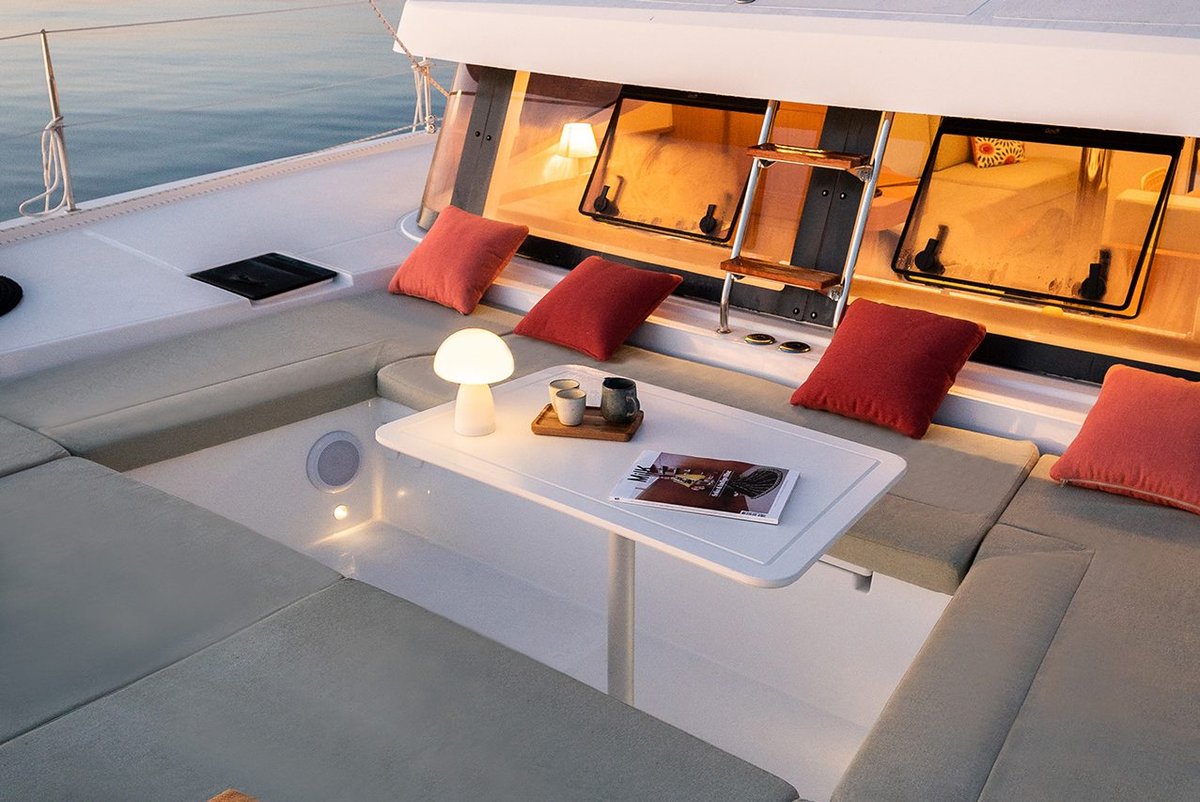
Layout and living aboard
The solid foredeck argument
The most distinctive feature of any Bali catamaran is the solid GRP foredeck where most competitors use a trampoline net. This gives you a massive, usable sunbathing and entertaining platform. As one poster on Cruisers Forum noted: "No trampoline up front, hard deck! Great space up by the helm" (anonymous poster, Cruisers Forum, 2021-08-13). The manufacturer states total usable deck area is 70.4 m² (757.5 ft²), a number that only makes sense when you stand on the foredeck and realise it's genuinely a living space rather than rigging real estate.
The trade-off is weight. The solid GRP foredeck adds significant mass compared to a net, contributing to the 9,200 kg light displacement (12,800 kg maximum loaded). That weight penalty shows up directly in sailing performance.
Interior configuration
Two layouts are offered: a three-cabin owner version and a four-cabin charter/family version. All cabins are ensuite. Maximum sleeping capacity reaches 10 in the four-cabin layout with bunk options, though some charter platforms list a maximum of 8 depending on configuration.
The galley includes a 265 L American-style fridge-freezer unit, a practical detail for extended cruising or provisioning for a full charter load. The large tilting 'Bali door' at the aft salon transforms the cockpit-salon boundary into a single open-plan space. Tim Murphy, a Cruising World judge, observed of the Bali Catspace concept: "On the charter, it was actually delightful" (Cruising World, 2022).
Mast height is 18.23 m (59 ft 9 in), worth checking against marina air-draft restrictions if you plan to keep the boat on a permanent berth. Draft is a shallow 1.10 m (3 ft 7 in), opening up skinny-water anchorages that deeper-keel monohulls and even some competing cats cannot reach.
Where she earns her keep
The Catspace works best in warm-water, moderate-wind cruising grounds. Think Mediterranean summer, Caribbean trade-wind seasons, and Southeast Asian coastal cruising. The first Asia unit was delivered to Hong Kong in 2020. The shallow 1.10 m draft lets you tuck into coral-fringed anchorages, and the 760 L water capacity buys autonomy between marina stops.
Multihulls World conducted an extended sea trial of approximately 400 NM in the western Mediterranean, covering wind conditions from 0 to 21 knots and calm to moderate sea states. In those conditions, the boat showed what it was designed for: comfortable passage-making with a bias toward liveability over speed. Cruise tests confirmed roughly 5 knots in moderate wind.
The self-tacking jib makes short-handed sailing genuinely easier. You can tack without leaving the helm, which matters on a boat where the narrow side decks make mid-ship sail handling awkward. For anyone planning to own a yacht and manage real running costs, the modest engine options (standard 2 × 19–20 HP) keep fuel consumption reasonable, though the 400 L tank won't take you far under power alone.
This boat earned a 2021 Multihull of the Year nomination and a 2022 Cruising World Best Boat nomination. Both reflect the industry's recognition of its space-per-foot proposition rather than any sailing-performance breakthrough.
Weak points and what they cost
✓ Strengths
- •70.4 m² usable deck area — largest in class at launch
- •Flybridge with helm on a 40 ft cat — unique at launch
- •Self-tacking jib simplifies short-handed sailing
- •1.10 m draft opens shallow anchorages
- •CE Cat A ocean certification
- •760 L fresh water for extended autonomy
✕ Trade-offs
- •Under-canvassed: 79 m² upwind, poor in light air
- •Solid foredeck slapping in head seas
- •Hydraulic steering lacks tactile feedback
- •Bali door mechanism requires regular inspection
- •Narrow side decks for sail handling
- •Solid foredeck weight penalty vs trampoline cats
Sailing performance
This is the elephant on the foredeck. The standard sail plan of 79 m² upwind (main 49 m² plus self-tacking jib 30 m²) is small for a catamaran with 9,200 kg light displacement. Owner "yeloya" on Cruisers Forum was blunt: "The boat's worst part is the sailing ability which is close to none" (Cruisers Forum, 2020-11-15). European Yacht Brokers' review diplomatically notes the boat is "not focused on speed." If you plan to sail rather than motor-sail, budget for the optional 52 m² gennaker or investigate an upgraded flat-top mainsail. Without downwind canvas, anything below Beaufort Force 3 (7–10 knots) will likely require engine assistance.
Bridgedeck slap
The solid foredeck creates audible slamming when beating into a chop. Bali counters that the hull design inherits Catana's high bridgedeck clearance engineering specifically to minimise this, and the clearance does help. But the solid surface amplifies the noise compared to a trampoline, which simply lets water pass through. In confused head seas, some owners also report a hobby-horse motion that differs from net-deck cats. Neither is a safety concern, but both affect comfort and sleep quality on overnight passages.
The Bali door
The large tilting salon door is the boat's party trick and its maintenance headache. The hydraulic/electric mechanism uses struts, tracks, and seals that need regular inspection for misalignment and wear. A failed door compromises both security and climate control. Budget for annual inspection of struts and seals. Replacement struts, if needed, are a dealer-sourced part. Get the door mechanism inspected as part of any pre-purchase survey.
Steering feel
Standard fully hydraulic steering provides a dampened feel with minimal tactile feedback compared to cable-steered competitors. If you value helm feel for sail trim, test it against a cable-steered rival before committing.
Side decks
Owners and charterers consistently note that the side decks are narrow, making mast-base and mid-ship sail handling awkward. The flybridge helm partially compensates by keeping the driver out of the traffic zone, but foredeck sail changes require confidence and sure footing.
How it ages
The Catspace has been in production since 2020, so the oldest examples are now six years old. The GRP infused foam sandwich construction with Divinycell core is a well-proven method across the Catana Group's range, and the vinylester anti-osmotic treatment below the waterline provides a first line of defence against blistering. All bulkheads are laminated to the hull rather than bonded, which is a structural plus for longevity.
No year-by-year design revision notices have appeared in open sources. The specifications appear unchanged across model years from 2020 to 2026 based on listing data. This simplifies parts sourcing but also means early boats don't carry a pre-facelift discount.
Key ageing items to watch on any pre-owned Catspace:
- Bali door struts and seals: inspect for alignment, leaks, and corrosion on tracks, especially on ex-charter boats with high cycle counts.
- Foredeck gelcoat: the solid foredeck is a large, sun-exposed GRP area; check for UV degradation, stress cracks, and non-skid wear.
- Engine hours vs. sail hours: given the boat's light-air limitations, ex-charter units may have disproportionately high engine hours. Check logbooks carefully.
- Standing rigging: standard inspection at 7–10 years, but check forestay and self-tacking jib track hardware for wear at any age.
Bali Catspace price: what the market asks
The Catspace launched at €298,500 ex-VAT in 2020. As of August 2026, the used and new market looks like this:
| Metric | Value |
|---|---|
| Launch price (2020, ex-VAT) | €298,500 |
| Current market range | €328,800 – €712,086 |
| Used 2021–2022 (ex-charter, P25 estimate) | ~€370,000 |
| Used 2023 (lightly equipped, P75 estimate) | ~€430,000 |
| Total listings across platforms | ~85–100 (new + used, significant overlap between aggregators) |
The P25 and P75 estimates are drawn from a small sample of visible listing prices (for example, €399,000 for a 2023 in Croatia, €420,000 for a 2022 in Sardinia, €439,800 for a 2024 in Croatia) and should be treated as indicative, not statistically robust. Platforms with active listings include YachtWorld (16 sail listings), Annonces du Bateau (14), iNautia (14), Boatshop24 (15), Botentekoop (18), and boats.com (20).
The wide price spread reflects the gap between bare ex-charter boats at the bottom and fully optioned, lightly used private boats or new inventory at the top. The 2 × 40 HP Yanmar engine upgrade, watermaker, air conditioning, and electronics packages can easily account for €50,000–€80,000 of specification difference between otherwise similar model years.
BT Market Snapshot
checked August 2026
~85–100 total across all platforms (new + used, sail + power versions); significant overlap between aggregator platforms. Updated count includes boats.com as an additional platform. Bali Catspace listed, asking 328,800–712,086, most between ~370,000 (used 2021–2022 charter-returned) and ~430,000 (used 2023, lightly equipped or ex-charter).
| Platform | Listings | Asking |
|---|---|---|
| YachtWorld | 16 (sail; incl. new and used) — confirmed pass-2 | not broken out by platform |
| Annonces du Bateau (French platform) | 14 (4 new, 10 used) | €328,800 – €712,086 |
| iNautia | 14 (4 new, 10 used) — confirmed pass-2 | €328,800 – €712,086 |
| Boatshop24 | 15 (6 new, 9 used) — confirmed pass-2 | $320,221 – $617,027 (≈€275,815–€531,462 at EUR/USD 1.161, corrected from pass-1 estimate) |
| Boat24 (German/Scandinavian platform) | multiple (count not displayed; used: 2022 boats from €385,400; 2023 from €388,800) | €385,400 – €439,280 (used visible listings) |
| Botentekoop | 18 (6 new, 12 used) | €357,600 – €702,669 |
Asking prices, not sale prices. Updated with each revision.
Who this boat fits / doesn't
Buy if you:
- Prioritise living space and deck area over sailing performance
- Want a flybridge on a 40 ft cat for visibility and entertaining
- Sail primarily in Beaufort Force 3–5 (7–21 knots) in warm waters
- Need shallow draft (1.10 m) for coral or sand-bar cruising
- Plan to charter the boat and want maximum guest appeal with ensuite cabins
- Prefer self-tacking simplicity for couple or family short-handed sailing
Look elsewhere if you:
- Want to sail in light air without engines: the standard rig won't keep you moving below Force 3
- Value helm feel and tactile steering feedback
- Need wide side decks for active sail handling or racing crew work
- Prefer the motion characteristics of a trampoline-foredeck catamaran in head seas
- Plan primarily upwind passages in confused seas where bridgedeck slap becomes fatiguing
Sailing Performance vs Living Space
Verdict
The Bali Catspace is a floating apartment that happens to have a mast. That sounds like a criticism. For the right buyer, it's the whole point. With 70.4 m² of usable deck, a flybridge unique in the 40 ft class, and ensuite cabins in every configuration, it delivers more liveable square metres per euro than almost any competitor. The 1.10 m draft and 760 L water capacity extend your cruising range into places deeper, thirstier boats can't follow.
The sailing performance is genuinely limited. If wind and canvas are why you go to sea, this is the wrong boat. But if you want to motor-sail comfortably through the Med, host guests in the Caribbean, or run a charter operation where the boat's interior sells the booking, the Catspace does that job well at a used entry point around €370,000 (as of August 2026).
The decision is simple: add up the hours you'll spend sailing versus the hours you'll spend at anchor, cooking, and entertaining. If the second number is bigger, the Catspace deserves your shortlist. If the first number is bigger, keep looking.
The Verdict
Choose Buy the Catspace if living space, shallow draft, and charter appeal matter more than sailing performance
Best for: Coastal cruisers, charter operators, and entertaining-focused families
Choose Skip the Catspace if you want genuine sailing ability in light air or value helm feedback
Best for: Performance-oriented sailors and committed upwind passagemakers
Method: Assembled from Bali Catamarans Official Website, Yachting World, SailboatData, Catamaran Gurus, Bali Catamarans Dealer Croatia, JFA Yacht; corroborated by Band of Boats listing ref 187966, Yacht Style; corroborated by Band of Boats listing ref 184322 (10 couchettes), Navigare Yachting Sales; construction detail corroborated by Katamarans.com review, including owner reports. Data checked 2026-08-19. Listings data reflects asking prices at the time of checking. This dossier of facts is not a substitute for a marine survey.
Bali Catspace price: new, used by year, and what moves it
New from €337,500 (2026, base price ex-VAT). Used prices below run by year and build era — the spread inside each band comes down to spec, charter history and how the boat surveys.
Bali Catspace Used Market Snapshot (2026)
| Years | Typical price (used) | What to check |
|---|---|---|
| 2025–2026 | €490,000–€712,000 | Fully-equipped charter-spec and delivered new listings dominate this band; 2026 model listed at €708,260 (fully equipped, US East Coast delivery) vs. base-configured Spanish listings at lower end; standard engines remain 2×40 hp Yanmar sail-drives, some 2026 listings spec Nanni 76 hp; verify CE Class A ocean certification is present and that the electric tilting 'Bali door' mechanism has been serviced. |
| 2023–2024 | €385,000–€560,000 | Wide spread reflects owner's-version (3-cabin/3-head) vs. 4-cabin charter layout premiums; 2023 BVI-based units ask €388,800–€399,000; 2023 Hungary-listed unit asks €520,000; check hours on the generator and watermaker, condition of the foredeck rigid cockpit composite panels, and whether the Excellence Package options (solar, electric winches, watermaker) were factory-fitted or retro-added. |
| 2022 | €353,000–€638,000 | Very wide band: standard sail version (2×40 hp Yanmar, Tortola) at €385,400–€405,000; high outlier at €638,000 is the rare power-cat variant with 2×250 hp engines (Croatia); low outlier at €353,000 is a stripped, ex-charter unit (France); for sail units, inspect the mainsail traveller and boom vang hardware (reported wear in charter fleets), flybridge helm station wiring, and osmotic blister risk on the bridgedeck. |
| 2021 | €330,000–€400,000 | Early-production hulls; Catspace launched at boot Düsseldorf 2020 and first hulls delivered mid-2020; 2021 boats are first-generation builds—check for any warranty work on the solid foredeck nacelle bonding, opening door pivot hardware, and early sail-drive alignment; Boatshop24 lower bound for this vintage sits at approx. €320,000 USD-equivalent. |
| New | from €337,500 | Base price ex-VAT — ask us for current delivery slots |
The Bali Catspace holds value unusually well for a 40-foot cruising catamaran: listings from 2021–2023 routinely ask 80–95% of their original equipped purchase price, consistent with the brand's strong charter demand and limited used supply relative to new-build wait lists. Depreciation is most visible in the first 1–2 years post-delivery (roughly 10–15% off fully-equipped new price for a well-maintained unit), then largely plateaus, particularly for owner's-version 3-cabin boats which attract a premium over the more common 4-cabin charter layout.
The Catspace is one of the most common bareboat charter catamarans in the Caribbean and Mediterranean, and ex-charter units typically trade at a 10–20% discount to comparable private-use boats, with larger discounts for high-hour 4-cabin fleet boats; buyers should verify maintenance records from the charter company, as hull wear, interior soft furnishing condition, and dinghy/davit hardware fatigue are the primary cost items on exit from a commercial program.
How these prices compare across sizes and types → · Could this boat pay for itself in charter? → · What to check on a used Bali Catspace →
Looking for a Bali Catspace?
We know this market and where the good ones are — new or used, wherever she happens to be. Tell us what you're after and we'll find you the best option.
Sources
- Cruisers Forum – Bali Catamaran Owners thread· forum
- Cruisers Forum – Bali Catspace opinions thread· forum
- Cruising World – Sailboat Review: Bali 4.6 and Catspace (2022 Boat of the Year debrief)· test
- SailboatData· data
- Catamaran Gurus· yard
- Katamarans.com review· data
- Yacht Style· data
- Katamarans.com – Bali model history· data
- Yachting World· test
- Bali Catamarans Official Website· yard
- Navigare Yachting Sales; 2022 Best Boat nomination corroborated by Toprik and European Yacht Brokers· yard
FAQ
How much does a Bali Catspace cost in 2026?
As of August 2026, Bali Catspace listings range from €328,800 to €712,086 across major platforms. Used 2021–2022 ex-charter boats start around €370,000, while 2023–2024 models in good condition typically list around €430,000. The boat launched at €298,500 ex-VAT in 2020.
What are the main problems with the Bali Catspace?
The most commonly reported issues are poor light-air sailing performance (the standard 79 m² upwind sail plan is small for the 9,200 kg displacement), bridgedeck slapping noise in head seas from the solid foredeck, hydraulic steering with minimal tactile feedback, narrow side decks for sail handling, and the Bali door mechanism requiring regular inspection for strut and seal wear.
Is the Bali Catspace good for ocean crossings?
The Catspace holds CE Category A – Ocean certification for 10 persons, so it is rated for open ocean use. However, its limited light-air sailing performance means you would likely motor-sail extensively in calms, and the 400 L fuel capacity is modest for long passages. The solid foredeck can produce uncomfortable motion in confused head seas compared to trampoline-foredeck catamarans.
How many cabins does the Bali Catspace have?
The Catspace is available in two layouts: a 3-cabin owner version or a 4-cabin charter/family version. All cabins are ensuite. Maximum sleeping capacity is 10 in the 4-cabin layout with bunk options, though some charter platforms list a maximum of 8 depending on configuration.
Does the Bali Catspace sail well?
Sailing performance is the Catspace's most significant weakness. The standard upwind sail area of 79 m² (main 49 m² plus self-tacking jib 30 m²) is small for a 9,200 kg catamaran. Cruise tests showed roughly 5 knots in moderate wind, and owners report the boat struggles to sail in under 10–12 knots of wind. Adding the optional 52 m² gennaker improves downwind performance significantly.
Compare with
Bali 4.4
ReviewBali 4.2
ReviewLagoon 40
ReviewLagoon 42
ReviewFountaine Pajot Elba 45
ReviewFountaine Pajot Isla 40
ReviewSwan 65
DossierSolaris 44
DossierAlso in: Best 40-foot sailboats →


