Beneteau First 31.7 Review: Racing DNA in a Production Hull (2026)
The Beneteau First 31.7 is a Finot-Conq-designed, tiller-steered cruiser-racer built from 1997 to 2010, with over 1,500 units produced. Displacement is 3,750 kg, LOA 9.61 m, and it carries CE Category A (deep keel). As of August 2026, used prices range from €33,900 to €58,000 across roughly 55–60 listings in Europe.

9.61 m
LOA
Length Overall
3,750
kg
Displacement
1,500+
units
Production Count
€33,900–€58,000
Price Range (Aug 2026)
What the Beneteau First 31.7 actually is
The First 31.7 comes from Finot-Conq Architectes, the same studio that drew the Beneteau Figaro solo-racing boat. The 31.7 hull descends directly from that Figaro lineage. Built between 1997 and 2010 (as of August 2026), over 1,500 units left the yard, making it one of the two best-selling models in the entire First range alongside the First 35. That volume matters: parts are available, surveyors know the type, and you will find comparison boats when it is time to sell.
At 9.61 m LOA with a waterline of 8.80 m, the ratio of sailing length to overall length is unusually generous. The beam is a moderate 3.23 m. Displacement sits at 3,750 kg, and the deep-keel version draws 1.90 m with an L-shaped fin and bulb, earning CE Category A certification (wind below Force 9, seas below 10 m). A shoal-draft option at 1.50 m carries CE Category B (wind below Force 8, seas below 8 m).
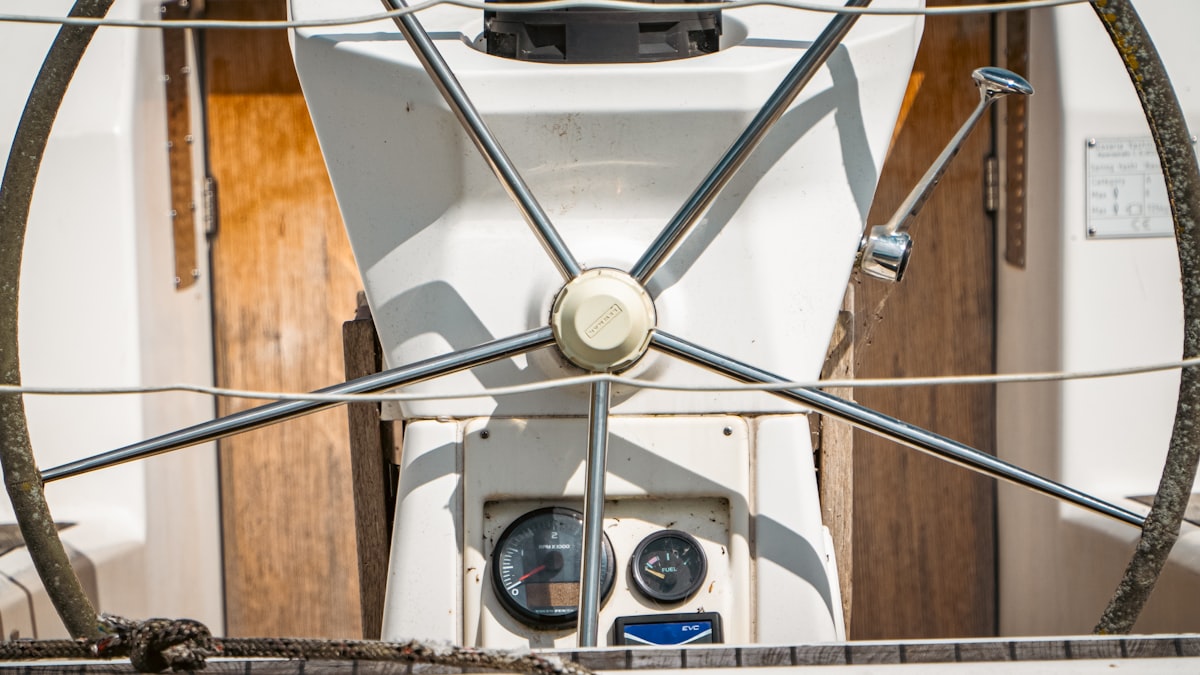
Steering is tiller-only. Beneteau never offered a wheel option. A push-button extending tiller extension was standard. The rig is a nearly masthead fractional sloop with a keel-stepped Sparcraft mast, double spreaders, and no runners. Upwind sail area with a 140% genoa is approximately 46 m², though this figure comes from editorial review rather than an official Beneteau brochure. PHRF rating sits around 132–144, and the boat holds World Sailing recognition as a one-design class with active European fleets racing in events like the Tranquadra and Vieux Safran offshore races.
Power comes from a 21 HP diesel inboard (Yanmar or Volvo Penta MD2020, depending on year) driving through a saildrive. Read the fuel section carefully before planning any long delivery passages.
Layout and living aboard
Below decks
Two cabins and a single head is the standard arrangement: a forward double berth and an aft-port double, plus two saloon berths that bring the total to six. Standing headroom is 1.80 m, adequate for anyone under about 5'11" but tight for taller crew. Water tankage of 160–190 L is respectable for weekend cruising but demands discipline on a week-long passage with four aboard.
The interior is functional, not generous. This was always a boat that put the cockpit and the rig ahead of the saloon. Stowage is limited, and owners on the YBW Forum have been candid about it.
On deck
The cockpit is wide, self-draining, and closed aft. A large lazarette sits to starboard for fender and line stowage. The mainsheet traveller bisects the cockpit, and teak slats were an option from the factory. Air draft is 14.50 m, which rules out some canal routes but is standard for a 31-footer with a keel-stepped mast.
The tiller delivers direct helm feel that racing sailors prize. For family cruising, it takes up considerably more room than a wheel and limits the cockpit's social space. You cannot sit centrally behind a tiller the way you can behind a pedestal.
Where she earns her keep
The First 31.7 was designed for the sailor who wants to race on Saturday and cruise on Sunday. That duality is real, not marketing copy. Professional sail tests report the hull is capable of planing on a deep reach in 25-knot gusts and tracks well upwind with no tendency to broach in strong wind. Tiller feedback is immediate, and on a boat this light, small trim changes translate directly into speed.
For club racing under IRC or PHRF, the boat is competitive in mixed-fleet events, though one YBW Forum member noted: "The 31.7 has a silly IRC handicap of 0.968 whereas the Sunfast rates around 0.950" (YBW Forum, July 2002). Check your local fleet's rating before buying for racing purposes. The handicap can feel punishing against newer designs.
One-design racing eliminates that problem entirely, and active European fleets mean regular competition if you are based in France, Ireland, or the UK. If you are exploring how the best Beneteau models to charter compare for hands-on sailing, the First 31.7 sits at the performance end of the range, far removed from the beamy cruisers that dominate charter fleets.
Cruising vs Racing Suitability
Weak points and what they cost
Start with the good news: owners genuinely like this boat. As one anonymous YBW member put it: "We have one of the Irish 31.7's and we think it's a great boat" (YBW Forum, October 2002). The hull's Figaro lineage gives it sailing manners that many 31-footers cannot match, and the sheer production volume means the type is well understood by yards and riggers across Europe.
Here is what goes wrong and what you should budget for.
✓ Strengths
- •Figaro-derived hull: proven performance pedigree
- •1,500+ built: strong parts and knowledge base
- •CE Category A (deep keel): offshore-rated
- •Active one-design class: good resale in racing markets
- •Direct tiller feedback: rewarding sailing feel
✕ Trade-offs
- •30 L fuel tank limits motoring range severely
- •Balsa-core deck prone to water ingress at penetrations
- •Tiller bisects cockpit; no wheel option
- •Trim-sensitive in gusts; demands attentive helming
- •Slippery curved cabintop in wet conditions
Structural concerns
Balsa-sandwich deck water ingress: The deck is sandwich balsa/GRP construction, and factory sealing around penetrations (stanchion bases, cleats, instrument holes) was not always watertight. Water entering the core causes balsa rot, which is expensive to repair because it requires cutting out sections and replacing the core. Budget €2,000–€5,000 depending on extent. Every pre-purchase survey must include percussion testing and moisture meter readings across the entire deck.
Hull/inner-liner separation: At least one documented case on the Sailing Anarchy Forum describes the hull and inner liner stringer separating forward of the mast and at the aft-most liner-hull joint after a grounding. Repair involves re-bonding with epoxy and colloidal silica. If you are buying a boat with any grounding history, insist on a thorough internal inspection of the liner bonds.
Osmosis on pre-2000 hulls: The hull is single-skin GRP polyester. Boats from the late 1990s are at higher risk for gel-coat osmosis blistering. Treatment (peel, dry, epoxy barrier coat) typically costs €3,000–€6,000 for a 31-footer, but the solid glass laminate means the structural risk is low even if blisters appear.
Practical limitations
30-litre fuel tank: This is the number that stops conversations. Thirty litres is about 8 gallons. With a 21 HP diesel, motoring range in calm conditions is extremely limited. Carrying jerry cans is the common workaround, but it adds deck clutter and is far from ideal. If you plan any canal transits or windless Mediterranean passages, this is a genuine constraint.
Tiller in the cockpit: The tiller and its extension consume significant cockpit volume. For a couple sailing shorthanded, this is fine. For a family of four trying to eat dinner in the cockpit, it is a problem. One YBW Forum member described the boat as "far too lively, trim sensitive and with not a lot in the way of stowage" (YBW Forum, July 2002) for genuine family cruising.
Slippery cabintop: The curved, undulating cabintop surfaces become hazardous when wet. Non-skid overlays or Kiwi Grip applied to high-traffic areas is a sensible aftermarket fix at €200–€400 in materials.
Stiff tiller in strong wind: Tiller load increases noticeably when the breeze builds. Singlehanding in Force 5+ requires early reefing or an autopilot tiller pilot to manage the load.
How it ages
The First 31.7 ages like most Beneteau production boats of its era: the hull is sound, the deck needs attention, and the rig components have a finite life. A Sparcraft mast from 1998 is now approaching 28 years old. Standing rigging should have been replaced at least once (every 10–12 years is standard practice). If it has not been, add €3,000–€5,000 to your budget immediately.
Saildrive seals need regular inspection. The Yanmar or Volvo diesel engines are well-supported with parts availability, and at 21 HP the loads are low, so engine hours matter less than maintenance quality. Look for complete service records and oil analysis reports.
The GRP hull itself is robust. Single-skin polyester layup from a major production builder does not degrade structurally over 25 years if the boat has been stored and maintained reasonably. Keel bolts on boats this age should be inspected. The L-shaped fin keel with bulb is a high-aspect design that loads the keel-hull interface more than a long-chord fin.
Interior woodwork on Beneteau boats of this generation is predominantly veneered marine ply. It holds up well if the accommodation has stayed dry, but delamination around the head compartment and under portlights is common if seals have failed.
Beneteau First 31.7 price: what the market asks
As of August 2026, roughly 55–60 used First 31.7s are listed across European and international platforms. Asking prices range from €33,900 at the bottom (older boats on French classifieds) to €58,000 for well-equipped later models. The 25th percentile sits at approximately €42,000, and the 75th percentile at approximately €52,000.
BT Market Snapshot
checked August 2026
~55–60 total across all platforms (Aug 2026): 5–6 on YachtWorld, 17 on boats.com, 4 on Band of Boats, 14–16 on Annonces du Bateau, 21 on iNautia, 1+ on Boat24, 2+ on leboncoin Beneteau First 31.7 listed, asking 33,900–58,000, most between ~42,000 and ~52,000.
| Platform | Listings | Asking |
|---|---|---|
| YachtWorld (international) | 5–6 | unknown (individual USD prices not extracted) |
| boats.com (US-centric, international) | 17 used | $25,000–$100,000 USD (approx. €23,000–€92,000) |
| Band of Boats (French platform) | 4 confirmed (2006–2007 models, listed Dec 2025 – Feb 2026) | €44,900–€55,000 |
| Annonces du Bateau (annoncesbateau.com) – French classifieds | 14–16 used | €39,748–€56,000 |
| iNautia (pan-European) | 21 used | €39,341–€58,000 |
| leboncoin.fr (French classifieds) | 2+ confirmed | €33,900–€46,900 |
Asking prices, not sale prices. Updated with each revision.
| Platform | Listings | Price Range (EUR) | Notes |
|---|---|---|---|
| YachtWorld | 5–6 | Not extracted | International listings |
| boats.com | 17 | ~€23,000–€92,000 | USD converted; wide range includes US boats |
| Band of Boats | 4 | €44,900–€55,000 | 2006–2007 models |
| Annonces du Bateau | 14–16 | €39,748–€56,000 | 1998–2005 models |
| iNautia | 21 | €39,341–€58,000 | 1998–2008 models |
| Boat24 | 1+ | €34,000 | 2007 model confirmed |
| leboncoin | 2+ | €33,900–€46,900 | French classifieds |
The sweet spot for most buyers is a 2003–2007 model in the €42,000–€52,000 range. These boats are old enough to have depreciated past the steep part of the curve but recent enough that major structural issues (osmosis, deck core rot) should be visible and either addressed or priced in. A boat below €38,000 will almost certainly need investment in rigging, sails, or deck repairs. Factor €5,000–€10,000 for deferred maintenance on a cheap example.
Who this boat fits, and who it doesn't
Buy it if you are:
- A club racer who also wants to cruise weekends and short holidays with a partner
- A competent sailor who values helm feel and performance over deck space
- Looking for an affordable entry into one-design class racing in Europe
- A couple sailing shorthanded who put how the boat sails ahead of how it entertains
Look elsewhere if you are:
- A family of four wanting comfortable coastal cruising with children in the cockpit
- Planning extended liveaboard or long-distance passages (30 L fuel tank, limited stowage)
- A novice sailor uncomfortable with tiller steering and a trim-sensitive hull
- Someone who needs interior volume and standing headroom above 1.80 m
Verdict
The Beneteau First 31.7 is a genuine performance sailboat that costs cruiser money. Its Figaro-derived hull delivers sailing that most production 31-footers cannot match, and the 1,500+ production run (as of August 2026) means the boat is well-supported, well-understood, and easy to resell in the right market. Tiller steering, a lively helm, and proper racing credentials are the reasons to buy one.
The reasons not to are equally clear. A 30-litre fuel tank is a serious constraint. The cockpit works for racing crew but not for a family at anchor. Headroom and stowage are racing-boat compromises, not cruising-boat generosities. Any example over 20 years old needs careful surveying of deck core, keel attachment, and standing rigging.
The decision is straightforward: if you sail more than you sit in the cockpit, and if you have a second crew member who shares the watch, the First 31.7 at €42,000–€52,000 is one of the best-performing 31-footers available for the money. If cockpit space, fuel range, or family comfort rank higher than helm feel, look at the Oceanis range instead.
The Verdict
Choose Buy the First 31.7 if you prioritise sailing performance and club racing on a sub-€50k budget
Best for: Couples and experienced sailors who race and cruise
Choose Skip the First 31.7 if you need family cockpit space, motoring range, or liveaboard comfort
Best for: Families, novice sailors, or long-distance cruisers
Beneteau First 31.7 price: new, used by year, and what moves it
Beneteau First 31.7 Used Market Snapshot (2026)
| Years | Typical price (used) | What to check |
|---|---|---|
| 2007–2010 | €48,000–€66,000 | Latest build years; Yanmar 3YM20 (21 hp) engine standard by this period; deep-draft L-shaped cast-iron keel or shoal option; balsa-sandwich deck — inspect all through-deck fittings for core moisture ingress; standing rigging now 15+ years old and overdue for replacement; check for deck delamination around chainplates and stanchion bases. |
| 2004–2006 | €42,000–€58,000 | Yanmar 20 hp inboard common; keel-stepped Sparcraft mast, double-spreader rig with no runners; cast-iron keel prone to surface rust staining at hull joint — probe for bolt corrosion; balsa-cored deck warrants moisture survey; tiller steering only (no wheel option); sails typically 15–20 years old and likely replaced. |
| 2001–2003 | €39,000–€55,000 | Volvo Penta or Yanmar diesel inboards of varying horsepower (14–21 hp); hull is single-skin fiberglass polyester (not vinylester), making osmotic blistering a real risk on untreated examples — confirm barrier coat history; cast-iron keel (L-profile bulb); rudder bearings (spade type) may have developed play; check bilge for water ingress around mast step. |
| 1999–2000 | €30,000–€55,000 | First production years of the model (launched 1999); hull shares direct lineage with Figaro 1/Figaro Solo racing monotype; Volvo Penta 2020 or Yanmar inboard; early hulls — priority survey items are osmosis, keel-bolt condition, and deck-core saturation around toerails and genoa track bolts; electronics and running rigging almost certainly original and end-of-life. |
| 1997–1998 | €25,000–€40,000 | Pre-series / very early production hulls; same Finot-Conq hull as later boats but construction finish varies; polyester resin laminate (not vinylester) — osmosis treatment history critical; engines approaching or past practical service life; few listings found in this range, pricing at lower end reflects age premium buyers apply. |
The First 31.7 has reached a stable floor price bracket (roughly €30,000–€66,000 across the full production run) consistent with a high-volume, well-regarded one-design class that still sees active racing fleets; listings across Band of Boats, iNautia, and Boat24 show limited price spread between mid- and late-production boats, suggesting depreciation has plateaued. Well-maintained examples with recent sails, rigging, and a clean survey command the upper end of the range with little discount pressure, while neglected boats drop sharply, indicating condition rather than age drives residual value at this stage.
How these prices compare across sizes and types → · What to check on a used Beneteau First 31.7 →
Looking for a Beneteau First 31.7?
We know this market and where the good ones are — new or used, wherever she happens to be. Tell us what you're after and we'll find you the best option.
Sources
- YBW Forum· forum
- YBW Forum· forum
- Sailing Anarchy Forums· forum
- Boat-Specs.com – Deep draft· yard
- Life of Sailing – Common Beneteau Issues· yard
- Sailboatdata.com· yard
- Good Old Boat – Saildata· yard
- Yacht and Boat Australia – First 31.7 Review· yard
FAQ
How much does a Beneteau First 31.7 cost in 2026?
As of August 2026, used First 31.7s are listed between €33,900 and €58,000 across roughly 55–60 listings on European platforms. The 25th percentile is approximately €42,000 and the 75th percentile approximately €52,000.
What are the common problems with the Beneteau First 31.7?
The most frequently reported issues are balsa-sandwich deck water ingress through poorly sealed penetrations, osmosis blistering on pre-2000 hulls, a very small 30 L fuel tank limiting motoring range, and the tiller consuming significant cockpit space. Hull/inner-liner separation has been documented after grounding events.
Is the Beneteau First 31.7 good for family sailing?
It can accommodate a family with 2 cabins and 6 berths, but owners describe it as trim-sensitive and lively, with limited stowage. The tiller takes up cockpit room, and headroom is 1.80 m. It suits experienced sailing couples better than families with young children.
What is the draft of the Beneteau First 31.7?
The deep-keel version draws 1.90 m with an L-shaped fin and bulb, carrying CE Category A certification. The shoal-draft version draws 1.50 m and is rated CE Category B.
How many Beneteau First 31.7s were built?
Over 1,500 units were produced between 1997 and 2010, according to Band of Boats and Good Old Boat (as of August 2026). No official factory production records are publicly available, but two independent editorial sources agree on this figure.


