Amel Super Maramu 2000 Review & Buyer’s Guide: The Blind Man’s Perfect Cruiser
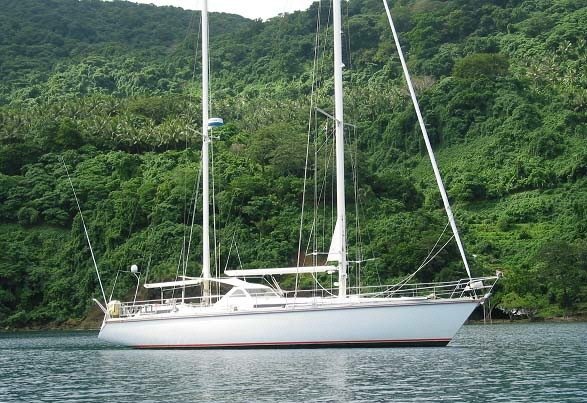
The boat a blind man designed
Henri Amel never saw the boats he built. He lost one eye in the war, and later, for years, most of the sight in the other. Even his name was his own invention: after fighting in Africa he declared that the man he used to be no longer existed. He was born Henri Tonet, in 1913.
Maybe that’s why his boats are put together like nothing else afloat. A sighted designer draws a boat to be admired. A blind one builds a boat to be understood by hand: every control where the palm expects it, every operation done from one place, nothing that needs to be found by eye. Amel refused to call his yachts cruisers. He called them “integrated cruising systems,” and he had one requirement: that a couple of no particular youth or strength could take a sixteen-metre ketch around the world without leaving the cockpit or lifting anything heavier than a glass. He also famously insisted that he wanted “women to enjoy being on board.”
The Super Maramu is the summit of that philosophy, and the most numerous serious ocean cruiser of its class: roughly five hundred hulls over eighteen years. Ask any round-the-world rally organizer what boat a couple should sail around the planet, and this name comes up first. And if you’ve ever watched sailing on YouTube, you already know this boat. Delos, the biggest sailing channel in the world, is a Super Maramu.
But Amel’s system has a price, and this page will be direct about it: you take the system whole, or you walk away.
“Either you buy in 100% or don’t go near Amels.”
The man behind the drawings
Amel’s biography reads like a novel. Wounded in the Resistance, blinded, and struck by the polyester pontoons of the Allied landings, out of which grew his pioneering of fiberglass in Europe. A yard in La Rochelle from 1965, a fire in 1967, the rebuild. Boats named after winds and capes. And a final gesture that explains the company better than any brochure: dying in 2005, four days short of his 92nd birthday, Amel handed 12,000 of the company’s 13,000 shares to his employees. The yard still belongs to the people who build the boats.
Hence a service culture owners describe with the same astonishment. One wrote to the yard about a cracked Lexan hatch on a fifteen-year-old boat: the next day came a reply with the part number, and three days later the part was in his hands, a perfect fit. A full rigging kit for a nearly eighteen-year-old hull reached Hong Kong in ten days. Parts for thirty-year-old boats are still on the shelf in La Rochelle, though some molds are gone for good, which is worth checking against your particular hull.
After the founder’s death the yard worked through successors (the 54, the 55, the 64) and in 2017 staged a quiet revolution: the Amel 50, the first sloop in twenty years. The age of the ketches was over. The Super Maramu remains its monument, and the market knows it.
What kind of boat is this — if you’re seeing her for the first time
The Super Maramu 2000 is a sixteen-metre fiberglass ketch: two masts, the sail plan divided into small, easy pieces, and everything, literally everything, driven by electric motors from buttons at the helm. Three things to understand straight away.
She is a system, not a collection of equipment. An ordinary boat is assembled from bought-in parts: one firm’s engine, another’s furlers, a third’s wiring. Amel designed and built nearly all of it himself, as one organism: a proprietary drive train, proprietary furlers, a proprietary retracting bow thruster, a 24-volt electrical plant. The upside: everything works with everything, down to the shopping trolley included as standard equipment (really). The downside comes up in the buying section: the parts and the know-how live mostly in one place, La Rochelle, and in the heads of the owners’ community.
She is as unsinkable as a production boat gets. Four full watertight bulkheads divide the hull into sealed compartments; the engine room is isolated entirely. The yard once ran a demonstration in Annapolis: they flooded the forward compartment and went sailing on Chesapeake Bay, nose down ten degrees.
One person runs her. Main and genoa furl into mast and headstay by motor; sheets come to powered winches; anchor and thruster work off buttons. Amel’s brief was literal: a couple past their athletic years, either of whom can do everything alone.
About five hundred were built: 243 classic Super Maramus from 1988 and 247 updated SM2000s from 1999 to 2006. So there are always some for sale. This is that rare thing, a cult boat with a living, liquid used market.
Living with her: what the ocean crossings say
Start with the honest part: she does not go to windward and does not pretend to. The genoa tracks sit on the bulwarks, the sheeting angles can’t be closed up, and 30 to 35 degrees apparent is the realistic ceiling. Owners answer this with the same unbothered calm.
“The shrouds are fastened to the sides of the boat so the genoa angle cannot be brought in to point very high. 30-35 degrees is a max. You also have a hundred horsepower engine and enough fuel to motor from New York to Bermuda. Getting off a lee shore is not a problem.”
Off the wind, though, this is one of the most fully-thought-out passage machines ever built. The signature system: two permanent poles, port and starboard, wing out two headsails at once, doubling the area, and both roll away on a single furler in seconds. No other builder ever copied it. A tradewind passage on a Super Maramu is weeks of steady miles with a glass in your hand, which is exactly what the boat was drawn for.
“Working the twin poles requires a precise procedure, but an extremely simple one once you’ve done it.”
And now the chapter that justifies the whole boat, if your route is longer than a holiday. October, New York to the Caribbean, Kimberlite. The forecast said 40 knots; then weather router Herb Hilgenberg came on the radio with the sentence the owner later used as his title: “In that case, prepare for survival conditions.” What followed was a full hurricane: gusts to 100 knots, sustained winds in the sixties, seas around sixty feet.
“On every watch we were pooped at least once.” Once he stood in cockpit water up to his armpits, “but the huge scuppers drained it in under thirty seconds. At times the entire boat went under. It was more like driving a submarine than a sailboat… and below, not a drop of water inside, no squeaking furniture. A bilge that is so dry that we keep paper towels in it.”
Thirty-six hours on a Jordan series drogue at two to three knots, and the boat brought them in. In the same storm, 150 miles to the west, a Swan 44 was dismasted and abandoned; her captain died. The watertight bulkheads that look like an indulgence at the dock, as another owner put it, “suddenly make sense when you cross the Pacific.”
Daily life matches the brief: a hard-top over the centre cockpit, a moulded helm seat like a car’s, a bathtub, dishwasher and washing machine as standard. No diesel stove needed. Unlike the Boréal, this boat was conceived to live between the fortieth parallels, not beyond them.
The great debate: Amel’s system — freedom or dependency
Every cult boat carries one eternal argument. On the Boréal they argue stability numbers. On the Super Maramu the argument is philosophical, and it matters more than any number, because it decides whether this is your boat at all.
The critics’ case sounds like a paradox, and nobody has put it more honestly than the owners’ own school:
“This operational simplicity is built upon a foundation of systemic complexity… The owner is not acquiring a simple boat, but rather a highly sophisticated one that is simple to sail.”
Meaning: under the buttons live dozens of motors, gearboxes and relays, each of which will someday want attention. The genoa furler’s gearbox was custom-made by a one-man machine shop in Switzerland; the owner has long since retired and the drawings are gone (bearings and seals, mercifully, are standard parts). A modern retrofit furler runs about $8,000. The early 24-volt installation was wired “above ground,” and early thruster circuits carried no fuse at all. You become your boat’s engineer, or you pay the people who did.
The defenders’ answer is just as convincing:
“What governs Amels of this generation is a concern for the practical and, contrary to appearances, simplicity of solutions. A failure of the electric furlers is solved, in an emergency, with one or two 13-mm wrenches.”
And it’s true: no boat on earth is documented like this one. A 400-page owner’s bible, an owners’ school, a forum where every part of every system has a thread with photographs, and a yard that ships parts for thirty-year-old hulls. Owning a Super Maramu means membership in the best-organized technical brotherhood in sailing. The only question is whether you want to join.
The honest summary: the debate never resolves because both sides are right. The system gives a couple capabilities no “simple” boat of this size can offer, and it charges for them in knowledge or in money. Our one piece of advice: decide before you buy which you will be, the engineer or the client. This boat offers no third option.
Buying a used Super Maramu: problems and what to check
Survey mode from here. Print this section and take it to the boat. Unlike most yachts, a Super Maramu survey revolves around the proprietary systems: the hull is boring in the best sense, but the system demands an audit.
The drive train (C-Drive)
The yard’s pride and the first item on your list. The engine sits amidships; power runs through two right-angle joints to a drive leg at the aft edge of the keel. Horizontal thrust, minimal vibration, a quiet boat under power. Brokers name it at random (C-Drive, U-drive, “Catep patented S-drive”); it is all the same device. What matters: the three shaft seals are changed through a removable sacrificial bearing without pulling the shaft, and the consumables are pocket change (a €7 seal, a bronze bushing around €134, per owners’ actual invoices), but the job needs a haul-out and someone who has done it before. A neglected drive is a different story: a complete replacement unit from the yard runs about €32,000, and a hull with a murky drive-service history should be priced accordingly. Ask when the seals were last done, by whom, and whether the bushing seat shows signs of amateur excavation.
Electric furlers
Test all of them under load, not at the dock. The motors last (Delos got thirteen years before the first rebuild), but the gearboxes want oil, not the grease-gun treatment that popular advice recommends. The Swiss genoa gearbox is unrepairable if the gear housing fails: donor unit or the $8,000 retrofit.
The bow thruster
Retracting, proprietary, three assemblies: a linear actuator for lift, a drive motor pulling around 485 amps, and the shaft with its propeller. The known diseases: corrosion of the motor’s steel base, power-cable insulation that crumbles with age (early hulls carry no fuse in this circuit, so a short is scarier than the failure itself), and ovalized propeller mounts. A complete leg cost owners €580–980 on real invoices; the motor rebuilds for $500–3,000. At survey: raise it, lower it, thrust both ways.
Electrics
The early “above-ground” wiring scheme has been converted to common ground on many hulls after real shore-power incidents; establish the status of yours. The 24-volt choice was deliberate (thruster currents at 12 volts would need cables as thick as your arm), but every piece of non-Amel electronics goes in through converters.
Rigging
A ketch means two full sets of standing rigging. The original supplier, ACMO, ships complete kits by hull number (one owner’s actual quote: €7,498 before freight), and the mechanical terminals let you swap stays one at a time alongside the dock. Insurers demand replacement every ten years; rigging older than that is an automatic bargaining item. Watch the headstay: its lower terminal is swaged, and “expert” yards have already ruined boats replacing it wrong.
Engines by year
Early SMs: Perkins, then the ubiquitous Volvo TMD22A (weak point: the turbo). Yanmar from 1999, and from 2003 the 100-hp Yanmar 4JH3-HTE became standard. That is the one to look for. Oil drops in the bilge under the engine are normal per the factory manual, not a symptom. The raw-water manifold on older hulls corrodes; look at it.
Hull and ballast
The ballast is cast iron, encapsulated in the fiberglass stub keel, on every series (the “lead” that appears in some listings is broker error). It hangs on 24 bolts with a double margin. Osmosis is rare on Super Maramus thanks to the yard’s barrier layer, but a moisture meter at haul-out is non-negotiable, especially on boats that have sat for years in the tropics. The deck “teak” is imitation (good news: zero upkeep), but it develops voids with age. Tap it.
Super Maramu price and market: a cult with a liquid used market
Here the Super Maramu is the Boréal’s exact opposite: there are always a dozen or two for sale on both sides of the Atlantic. As this dossier went to press the market looked like this: classic SMs from the late ’80s and ’90s from €130,000 (tired) to €195,000–255,000 (sorted, including hulls fresh from full service at the yard’s own Martinique base); SM2000s from 1999–2004 at €189,000–299,000, with the best examples around €270,000–290,000.
Three things to understand about this market.
Condition is everything; the year, almost nothing. The owners’ school cites four hulls with consecutive build numbers whose valuations spread across eighty thousand dollars. A typical catch-up refit on a good example runs €6,000–10,000; a neglected system (drive, furlers and rigging all at once) devours any price difference instantly.
The boat holds its money. Sellers are rarely in a hurry: a well-maintained Amel sells, and its owners know what they have. The mechanism is the same as the Boréal’s, only softer: a cult following plus the absence of any modern equivalent, since the yard builds no more ketches.
The Delos effect is real, but nobody has measured it. Brokers now write it into listings outright: the boat’s following “has been accelerated by the popularity of SV Delos on YouTube and showing what it is really like living on board.” Sellers tag boats as “Delos type”; buyers arrive having first seen an Amel on a screen. No one has put a number on the premium. But the seller across the table will hold their price with more confidence than ten years ago, and you should know that going in.
Super Maramu vs Hallberg-Rassy, Oyster and Hylas: what buyers actually compare
Hallberg-Rassy 46/48 is the eternal opponent, the choice of those for whom the Amel is “too strange.” The Swedes are prettier (even the Amel faithful concede the point: “never going to win the beauty pageant”), carry a lead bulb keel and a higher ballast ratio, and are brighter below. But an HR is a boat assembled from bought-in parts against a boat grown as one organism, and on the HR a human still hauls the sheets.
Oyster 485/53 is the British line in the same class: lead, 40% ballast ratio, prestige, and noticeably higher prices at the same age. The twin-headsail downwind rigs that Oyster owners praise had to be added; on the Amel they are in the DNA.
Hylas 49 is the quiet contender from the forums: 44% lead ballast (best in this company), a classic cutter, cheaper than an Oyster. Less cult, less system, more “simply a good boat.”
Amel 54 is the in-house successor and the main internal rival: a more modern hull, softer through a head sea, but its standard Bamar furlers proved troublesome enough that the supplier offered discounts on redesigned units, and the berths are smaller. Some SM owners tried the 54 and came back. It costs roughly double for ten years’ difference.
The formula the community has settled on: maximum automation and a couple’s circumnavigation conveyor, Super Maramu; beauty, pace and classicism, Hallberg-Rassy; prestige with budget, Oyster; value without the cult, Hylas; the same philosophy but younger and dearer, Amel 54.
Open questions
No documentary price list for a new boat survives in the open from the 1990s press; the price history here is reconstructed from the used market. A hull-by-hull registry of thruster failures exists inside the members-only owners’ forum and awaits systematization. The annual cost of ownership runs from “no dearer than her classmates” to a documented $50,000–60,000 a year from circumnavigators who logged every filter. That spread is honest, and we will narrow it with owner interviews. Their testimony will join the next revision.
Amel Super Maramu 2000 specifications (1999–2006)
| Length overall | 16.00 m |
| Waterline length | 12.60 m |
| Beam | 4.60 m |
| Draft | 2.05 m |
| Light displacement | 16,000 kg |
| Ballast | 5,500 kg cast iron, encapsulated (B/D 34%) |
| Sails (main / mizzen / genoa / staysail) | 35 / 19 / 65–67 / 20 m² |
| Rig | ketch, electric in-mast and headsail furling |
| Engine | Yanmar 75–100 hp (100 hp standard from 2003) |
| Fuel / water | 600 / 1,000 L |
| Construction | GRP, 4 watertight bulkheads |
| CE category | A |
| Built | ~490–497 (SM + SM2000), of which ~247 SM2000 |
FAQ
How much does a used Amel Super Maramu cost?
Classic Super Maramus run roughly €130,000–255,000 depending on condition; Super Maramu 2000s from €189,000 to around €299,000, with the best examples near €270,000–290,000. Condition matters far more than year: consecutive hull numbers have been valued $80,000 apart.
What are the known problems of the Super Maramu?
They cluster around the proprietary systems: shaft seals and neglected maintenance on the C-Drive (full replacement ~€32,000), the irreplaceable Swiss genoa-furler gearbox, bow thruster motor and actuator failures, aging 24V wiring on early hulls, and standing rigging due every ten years (~€7,500 per kit). The hull itself is famously robust.
Can a couple really sail a Super Maramu around the world?
That is precisely what it was designed for, and hundreds have. Every sail handling operation is electric and led to the centre cockpit; rally organizers routinely name it the definitive couple’s circumnavigator.
What’s the difference between the Super Maramu and the Super Maramu 2000?
The SM2000 (1999–2006) brought a richer interior, improved refrigeration, a single consolidated raw-water intake and, from 2003, a standard 100-hp Yanmar. The classic SM (1988–1998) is plainer and carries the older Perkins or Volvo engines.
Amel Super Maramu or Hallberg-Rassy 46?
Super Maramu for full automation, watertight bulkheads and the couple’s-conveyor concept; Hallberg-Rassy for looks, windward performance, lead ballast and standard replaceable parts. The Amel demands you accept its integrated system; the HR demands you work your own sheets.
Method: this dossier was assembled from the yard’s documentation and owner’s manual, reviews by Wave Train, Cruising World and Ocean Navigator, the technical write-ups of Bill Kinney (Fetchin’ Ketch, Cruising Consulting) and the Amel Owners Yacht School, owners’ actual service invoices (Nikimat), threads on Hisse-et-Oh, SailNet and the Amel owners’ forum, and brokerage archives 2016–2026. Quotes are translated from French where marked; English quotes are given as written. Where sources disagreed, we either resolved the conflict with data (ballast material, production totals) or left it honestly open. Owner interviews are underway; their testimony will join the next revision.
Compare with
Amel 54
DossierAmel 50
DossierDiscovery 55
DossierAllures 51.9
DossierOceanis 51.1
ReviewJeanneau Sun Odyssey 519
ReviewDufour 512
ReviewBeneteau Oceanis 54
ReviewAlso in: Best bluewater sailboats → · Best liveaboard sailboats →