Fountaine Pajot Lucia 40 Review: Two Models Replaced, One Winner (2026)
The Fountaine Pajot Lucia 40 is a CE Category A cruising catamaran built 2016–2019 in La Rochelle. LOA 11.73 m, 8.9 t unladen, twin Volvo Penta diesels. As of August 2026, used prices range from ~€130,000 (ex-charter 2016) to ~€415,000 (well-equipped 2019 Maestro), with roughly 90–100 listings across platforms.

11.73 m
LOA
Length Overall
8.9 t
unladen
Displacement
~€130k–€415k
Used price range
A
Ocean
CE Category
What the Fountaine Pajot Lucia 40 actually is
The ACI marina in Sibenik fills up by Thursday in July. The Lucia 40 won't make that problem worse: at 11.73 m LOA and a 6.63 m beam, it's wide enough for genuine liveaboard comfort and short enough to keep Med marina fees from becoming a monthly crisis. Fountaine Pajot launched it in 2016 as a replacement for both the Lipari 41 and the Lavezzi 40, designed by Berret-Racoupeau Yacht Design and built in La Rochelle. It won the European Yacht of the Year award in 2017 in its category.
Production ran from 2016 to 2019. The Isla 40, announced in July 2020, took its place. Fountaine Pajot doesn't publish production numbers, but hull #234 was confirmed by an owner on Cruisers Forum in June 2020, which gives a rough sense of volume. About 80% of FP's catamarans go to private owners rather than charter fleets, though the Lucia attracted both. Expect to find four-cabin charter versions alongside the three-cabin Maestro owner's layout on the used market.
Construction is PVC foam-core sandwich, vacuum-laminated GRP. Deck and coachroof are produced via RTM (resin transfer moulding) with gelcoat on both sides. The twin fixed mini keels draw just 1.20 m (1.25 m at medium load per the operation manual). According to FP's own documentation, they're designed to absorb grounding impact without hull damage. Standard power is a pair of Volvo Penta D1-20 engines at 20 HP each. Many US-market boats carry the optional D1-30 units at 29–30 HP each.
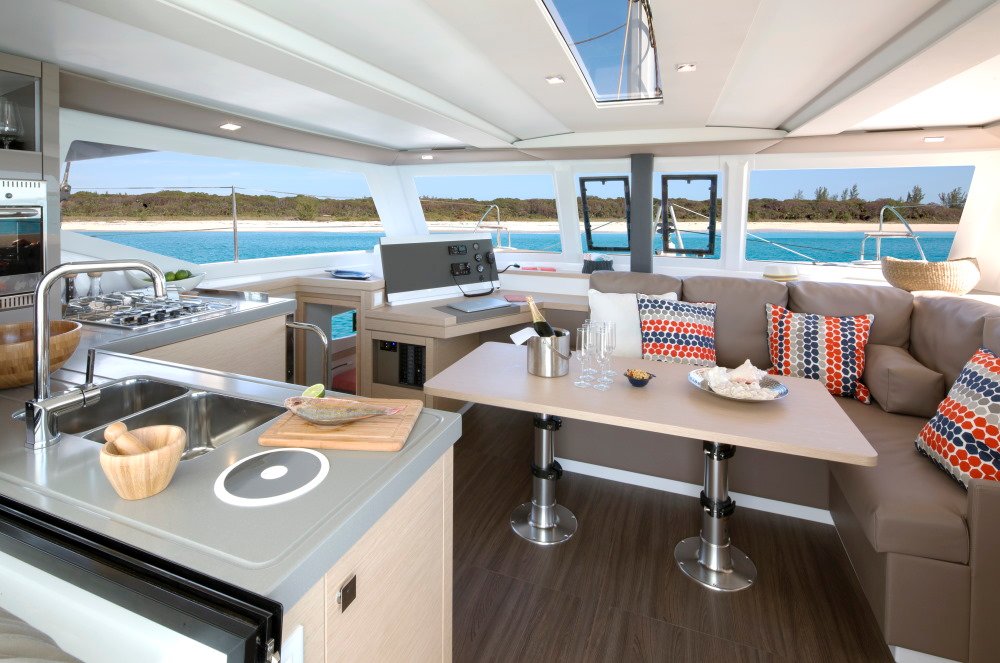
Layout and living aboard
Deck and cockpit
The cockpit is the headline number: roughly 12 m² (about 130 ft²) of outdoor living space. As one owner put it: "I like the boat very much. Large cockpit especially" (anonymous owner, Cruisers Forum, July 2021). That's where most of your waking hours happen in warm climates, and the Lucia delivers it at a size usually reserved for 42–45 ft competitors.
The trampolines forward are smaller than most rivals in the class. Fountaine Pajot traded net area for usable foredeck and interior volume. Unlike many competitors, the Lucia 40 has no forepeak cabins. Those bow spaces go to storage or a washer-dryer. If you prioritise lounging on the nets underway, measure the area on a sea trial and compare it to alternatives.
Interior: Maestro vs. Quatuor
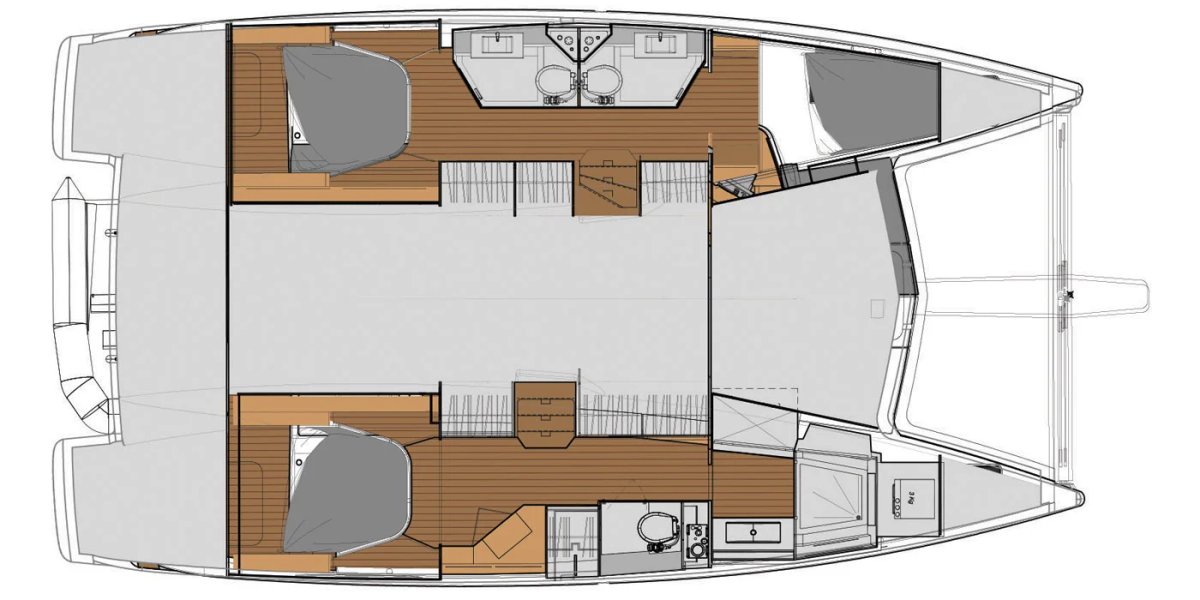
The three-cabin Maestro (owner's) version puts a full-beam master suite in the starboard hull with two guest cabins to port. Total berths: six. The four-cabin Quatuor, typical of charter boats, sleeps eight. Heads range from two to four depending on specification.
One persistent design quirk: the owner's version has no door between the toilet compartment and the stateroom. Multiple reviewers and owners flag this. Cruising as a couple, it's manageable. Hosting guests who value privacy, it's a notable compromise.
Water capacity is a generous 530 L (2 × 265 L tanks), strong for a 40-footer. Fuel is 300 L (2 × 150 L). Some charter platforms swap these figures. The FP brochure is authoritative. For couples weighing whether a boat of this size suits them or whether something smaller makes more sense, our guide to the best small cruisers for couples (32–36 ft) provides a useful comparison point.
Where she earns her keep
Sailing performance
The rig is a fractional sloop with furling genoa and reefing main, carrying 95 m² of sail area (main 58 m², genoa 37 m²). In Force 3–4 conditions, the Lucia is responsive enough to keep a crew entertained without demanding constant attention. Above Force 5, put the first reef in early. The 8.9 t unladen displacement combined with that sail plan means the boat loads up fast.
Cable steering rather than hydraulic is the factory choice. FP picked it for offshore repairability: you can fix a cable system at sea with basic tools. The trade-off is a stiffer helm with less feedback than hydraulic alternatives, and owners report finding it tiring on longer passages.
Cruising range and ICW clearance
Air draft of 19.3 m (63 ft 4 in) per the FP brochure makes the Lucia 40 one of the few standard production catamarans that clears the 65 ft Intracoastal Waterway bridge limit in the US, without antenna. That's a genuine selling point for East Coast cruisers. The operation manual gives 19.45 m without antenna and 20.0–20.5 m with antenna at medium load. Remove any whip antennas before attempting ICW bridges.
Load carrying capacity is 3,100 kg (6,834 lb), which compares well to many competitors of the same length. This matters for long-range cruising. Provisions, a watermaker, solar panels, and a dinghy with outboard add up fast on a catamaran.
Weak points and what they cost
Bow-heavy trim
When water tanks are full and no generator or air conditioning unit is fitted aft, the Lucia sits down in the bow. One owner confirmed it directly: "My Lucia sits down a bit in the bow" (anonymous owner, Cruisers Forum, September 2019). The cause is the concentration of tank weight and anchor chain forward by design. The fix is weight management: keep forward tanks partially filled during passages and move stores aft. No parts cost, but it requires awareness.
Genset installation quality
Factory generator installations have been reported with salt-water intrusion and poor exhaust and drain routing. Some owners rebuilt enclosures or replaced units entirely. If you're buying a boat with a factory genset, budget for a marine surveyor to inspect the installation specifically. Replacement costs vary widely, but expect €3,000–€8,000+ for a proper re-do, depending on whether the unit itself needs replacing.
Acrylic window crazing
The oversized acrylic salon windows look striking, but they're prone to surface crazing and scratching over time. Replacement is costly given the size of the panels. Inspect every window on any prospective purchase and factor in replacement if crazing is advanced.
Volvo D1-30 engine recall
At least one documented case exists of both D1-30 engines being replaced under a Volvo recall. The 2016 hull 'Refaire' had its engines replaced by the time of its 2026 listing. If the boat you're viewing has D1-30 engines, confirm recall compliance with Volvo before making an offer.
Other items to check
- Cored deck moisture: Vacuum-infused cored sections in the deck and interior panels need periodic inspection at through-deck penetrations to catch delamination or moisture ingress early.
- Boom height with hard dodger: If the optional hard dodger is fitted, the boom sits high enough to make tucking in and reefing the main awkward. Test this on a sea trial.
How it ages
The oldest Lucia 40 hulls are now roughly ten years old (2016 builds). The vacuum-infused construction holds up well structurally. FP's build quality at the hull level is consistent, and the foam-core sandwich with gelcoat on both sides resists osmosis better than solid laminate. The fixed mini keels are simple and robust.
The weak links as the boat ages are the acrylic windows, any through-deck hardware that wasn't bedded properly, and the genset installation if present. Charter boats will show wear in soft furnishings, helm station components, and galley surfaces. Owner-maintained private boats from the same year can be in dramatically better condition. The Maestro vs. Quatuor layout is often a proxy for how hard the boat has been used.
The Volvo D1-20 (standard) and D1-30 (optional) engines are well-supported globally. Parts availability is not a concern. With regular servicing, these small diesels should reach 5,000–8,000+ hours without major issues. Confirm recall status on D1-30 units.
Fountaine Pajot Lucia 40 price: what the market asks
As of August 2026, the original base price (new, ex-VAT) was approximately €294,000. Fully loaded boats reached €400,000–€450,000. The Lucia is no longer in production, so every boat on the market is used.
Roughly 90–100 listings exist across platforms, with significant overlap between them. The spread as of August 2026:
| Metric | Value (as of August 2026) |
|---|---|
| Lowest asking price | ~€130,000 (ex-charter 2016, VAT excl.) |
| Highest asking price | ~€415,000 (well-equipped 2019 Maestro) |
| Estimated 25th percentile | ~€210,000 |
| Estimated 75th percentile | ~€330,000 |
| YachtWorld listings | 27 |
| boats.com listings | 37 |
| Boatshop24 listings | 23 |
| BoatTrader (US) listings | 6 |
The sub-€200,000 boats are almost exclusively ex-charter four-cabin versions from 2016–2017. A privately owned three-cabin Maestro from 2018–2019 with reasonable equipment typically sits in the €280,000–€380,000 range. US-market boats listed in USD tend to price higher, partly reflecting the D1-30 engine upgrade and additional equipment common on that market.
What moves the needle on price
- Layout: Maestro (3-cabin) versions command a premium over Quatuor (4-cabin) charter layouts.
- Engine hours and recall status: Low-hour D1-30 engines with recall work completed are worth paying for.
- Genset condition: A well-installed, properly functioning generator adds value. A problematic one is a negotiating chip.
- Window condition: Crazed or scratched acrylic windows signal either a discount or a replacement cost to budget.
Who this boat fits and who it doesn't
It fits
A couple or a small family stepping into catamaran cruising for the first time. The Lucia 40 is small enough to handle shorthanded, carries enough water (530 L) and payload (3,100 kg) for extended coastal cruising, and its 1.20 m draft opens up anchorages that deeper-keeled monohulls can't reach. US East Coast sailors who need ICW clearance should put it on the shortlist immediately. Sub-65 ft air draft on a 40-ft cat narrows the field considerably.
It doesn't fit
Serious offshore passage-makers who want to cover distance fast. The standard 20 HP engines are adequate for manoeuvring but not for sustained motoring in calms. The cable steering, while repairable at sea, is fatiguing over a multi-day passage. Anyone who needs a fully private owner's head will find the open-plan toilet layout in the Maestro version a persistent irritation.
Charter operators looking for a fresh revenue-generating boat should look at the Isla 40 successor instead. The Lucia's production ended in 2019, and guests increasingly expect the latest model.
Cockpit Space (relative to 40ft class)
Verdict
The Lucia 40 is a well-built, well-thought-out coastal cruising catamaran that punches above its length in living space and payload capacity. Its weak points are real and known: bow-heavy trim, stiff steering, the open-plan head, window crazing. Most are either manageable through seamanship or fixable with money. None are structural.
The decision is straightforward. A privately owned Maestro from 2018–2019 in the €280,000–€380,000 range, with the D1-30 engines (recall completed), clean windows, and a properly installed genset, is a strong cruising platform for Mediterranean or Caribbean coastal sailing. If you're budget-constrained and willing to accept cosmetic wear, ex-charter boats below €200,000 offer a legitimate entry point. Budget an additional 10–15% of purchase price for refitting soft furnishings and inspecting the genset and windows.
The Verdict
Choose Privately owned Maestro (2018–2019) Best balance of condition, equipment, and remaining hull life
Best for: Couples or small families ready for serious coastal cruising
Choose Ex-charter Quatuor (2016–2017) Lowest entry price, but budget for refit
Best for: Budget-conscious buyers willing to invest sweat equity
Method: Assembled from YachtWorld listing, ManualsLib – FP Lucia 40 Operation Manual (primary); YachtWorld listing (1.20 m design draft), Catamaran Gurus (brochure, 8.9 t unladen); ManualsLib Operation Manual (9,520 kg medium load), Catamaran Gurus, ManualsLib – FP Lucia 40 Operation Manual; Catamaran Gurus (19.3 m); ACY blog (63.3 ft confirmed), ManualsLib – FP Lucia 40 Operation Manual (derived); remains open, Katamarans.com review, The Multihull Company, including owner reports. Data checked 2026-08-14. Listings data reflects asking prices at the time of checking. This dossier of facts is not a substitute for a marine survey.
Fountaine Pajot Lucia 40 price: new, used by year, and what moves it
Fountaine Pajot Lucia 40 Used Market Snapshot (2026)
| Years | Typical price (used) | What to check |
|---|---|---|
| 2019–2020 | €350,000–435,000 | Final production years; some boats show 2020 delivery dates (last builds before Isla 40 launch announced July 2020). Volvo Penta D1-30 2×30 hp saildrive standard on most late units (30 hp upgrade strongly recommended over base 20 hp spec). Vacuum-infused GRP hull — inspect cored deck sections around window frames and chainplate penetrations for water ingress, a known weak point of this construction method. Check 3-cabin (charter) vs 3-cabin Maestro (owner) layout as fitted equipment levels differ substantially. |
| 2018–2019 | €320,000–395,000 | Core production vintage with widest inventory on market. Standard rig: full-batten square-top mainsail with 110% overlapping genoa (no self-tacking jib option available from factory). Single starboard helm station limits sail trim from helm on port tack. Cable steering retained (not hydraulic) — heavier helm feel, prone to over-correction; inspect cables and sheaves. Verify engine hours on 2×20 hp base spec boats — underpowered in chop, many owners retrofitted 30 hp units. Confirm if 4-cabin charter configuration: check AC ducting, navigation table and galley wear typical of commercial use. |
| 2017 | €290,000–360,000 | First full model year after 2016 launch. Identical hull to later years (PVC foam-core sandwich, vacuum-laminated skins, RTM deck/saloon). Early-build quality control items to check: portlight bedding compound integrity (recurring window leak reports on early hulls), foredeck trampoline attachment points, and saildrive bellows condition. Inspect structural foam-cored coachroof — reported as less stiff than competitors of the period. Boats from this year may carry the base 2×20 hp Volvo D1-20 engines; confirm spec before survey. |
| 2016 | €249,000–310,000 | Launch year; model replaced the Lavezzi 40 and Lipari 41. Oldest examples now 8–9 years old — saildrive service history critical (bellows, seals). Earliest production units may have pre-series gelcoat and interior fit variations. Volvo Penta D1-20 (2×20 hp) standard; check if engines have been replaced or uprated. Forepeaks eliminated in this design vs predecessor — storage lockers fitted in bows; inspect for delamination or moisture. Fewest listings on market; negotiate hard as parts supply for oldest drives is not guaranteed. |
The Lucia 40 has shown reasonable value retention relative to its original ex-factory price of approximately €294,000, with used examples from all production years (2016–2020) currently listed between roughly €249,000 and €435,000 depending on year, fit, and condition — meaning the newest, best-equipped boats command a premium close to 50% above the base new price, reflecting strong demand and the model's discontinuation in 2020. Depreciation is modest for a discontinued model: 2019–2020 examples trade at roughly 15–25% below equivalent new replacement cost (the Isla 40/FP 41 successor line), while 2016–2017 hulls have depreciated more steeply (40–55% off launch price) as engine and drive service costs mount.
The Lucia 40 was widely adopted by charter fleets (4-cabin configuration was the standard charter layout) and a significant proportion of used inventory is ex-charter; these typically carry 500–1,500+ engine hours and high soft-goods wear, and trade at a discount of roughly €20,000–40,000 versus comparable private-use boats. Charter use on this model particularly affects saildrive bellows, winch internals, helm cable wear, AC systems, and galley surfaces — all should be surveyed carefully, and a full logbook/maintenance record should be requested.
How these prices compare across sizes and types → · Could this boat pay for itself in charter? → · What to check on a used Fountaine Pajot Lucia 40 →
Looking for a Fountaine Pajot Lucia 40?
We know this market and where the good ones are — new or used, wherever she happens to be. Tell us what you're after and we'll find you the best option.
Sources
- Cruisers Forum – Lucia Owners thread, page 11· forum
- Cruisers Forum – Lucia Owners thread, page 14· forum
- Cruisers Forum – Lucia Owners thread, page 12· forum
- Cruisers Forum – Lucia Owners thread, page 1· forum
- BolsadeNavegantes / The Sailboat Guide· yard
- 48° North (sail test review)· yard
- Katamarans.com review· yard
- Atlantic Cruising Yachts (ACY) blog· data
- The Multihull Company – 'Refaire' listing· yard
- Boat-Specs.com· yard
- Atlantic Cruising Yachts (ACY) blog· data
- ManualsLib – FP Lucia 40 Operation Manual· yard
FAQ
How much does a used Fountaine Pajot Lucia 40 cost?
As of August 2026, used Lucia 40 prices range from approximately €130,000 for an ex-charter 2016 hull (VAT excluded) to approximately €415,000 for a well-equipped 2019 Maestro version. The estimated 25th percentile is around €210,000 and the 75th percentile around €330,000. Roughly 90–100 listings exist across major platforms.
What are the common problems with the Fountaine Pajot Lucia 40?
The most commonly reported issues are: bow-heavy trim when water tanks are full and no genset is fitted aft; poor factory generator installations with salt-water intrusion; acrylic salon windows prone to crazing and scratching; stiff cable steering with poor helm feedback; and no door between the owner's head and stateroom in the Maestro version. Some D1-30 engines were subject to a Volvo recall — confirm status before purchase.
Can the Fountaine Pajot Lucia 40 fit under ICW bridges?
Yes. The Lucia 40 has an air draft of 19.3 m (63 ft 4 in) per the FP brochure, which clears the 65 ft Intracoastal Waterway bridge limit — without antenna. The operation manual gives 20.0–20.5 m with antenna, so remove whip antennas before attempting ICW bridges.
How many cabins does the Lucia 40 have?
The Lucia 40 comes in two main layouts: the Maestro (owner's version) with 3 cabins sleeping 6, and the Quatuor (charter version) with 4 cabins sleeping 8. Heads range from 2 to 4 depending on specification.
How many Fountaine Pajot Lucia 40 were built?
Fountaine Pajot doesn't publish production numbers. The highest hull number reference found is #234, confirmed by an owner on Cruisers Forum in June 2020, roughly four years into the production run (2016–2019). The Isla 40 replaced it, announced July 2020.
Compare with
Fountaine Pajot Isla 40
ReviewFountaine Pajot Astrea 42
ReviewLagoon 40
ReviewLagoon 42
ReviewBali Catspace
ReviewBali 4.1
ReviewSwan 65
DossierMalö 43
DossierAlso in: Best 40-foot sailboats →


